
Now Reading: Easter Island Travel Guide: Top Attractions, Tips, and Hidden Secrets
-
01
Easter Island Travel Guide: Top Attractions, Tips, and Hidden Secrets

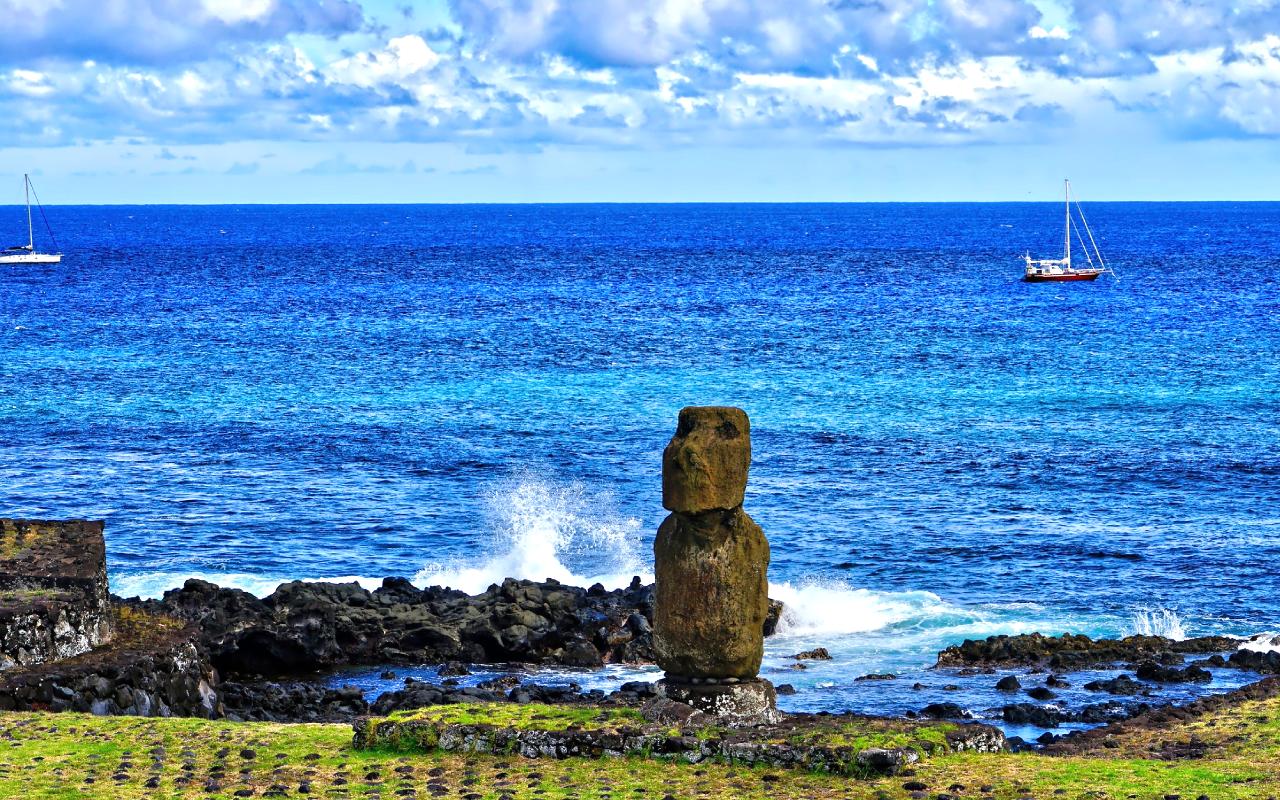
Introduction: Discovering the World’s Most Mysterious Island
Easter Island (Rapa Nui) is a small volcanic island located in the South Pacific, which is known for its giant stone moai statues. As part of Chile, it is over 3,500 kilometers away along the coast of mainland South America. It is one of the most distinctive tourist destinations in the world due to its solitude, mystical past, and moai statues, which are iconic.
The rough volcanic terrain, unspoilt beaches, and the Polynesian culture contribute to the attraction of the island.
In this guide, you will learn about Easter Island’s geography and history, its enduring mysteries, the must-see moai sites, and practical travel tips.
By the end, you’ll understand why it, nicknamed the “navel of the world”, should be on every traveler’s bucket list.
Where is Easter Island? (Geography & Location Guide)
Easter Island lies in the southeastern Pacific Ocean, roughly 3,510 km (2,182 miles) west of continental Chile and about 2,075 km from nearby Pitcairn Island. It is Chile’s westernmost territory and marks the southeast corner of the Polynesian Triangle (to Hawaii and New Zealand).
The island itself is quite small, only about 23 by 11 km (163 km²) in area, and is mostly a flat triangular plateau topped by three extinct volcanoes (Terevaka, Poike, and Rano Kau). Its highest point, Terevaka, reaches 600 m above sea level.
The extreme isolation is a defining feature. Easter Island is often called “one of the most remote inhabited islands on Earth”. The nearest inhabited place is Pitcairn Island, over 2,000 km away, and the nearest continental land is roughly 3,500 km distant.
This remoteness has both protected and mystified Rapa Nui: it preserved a distinct Polynesian culture yet also cut off support during ecological crises. Because of its small size and flat terrain, the island is often windy and exposed; tropical cyclones are rare, but trade winds keep temperatures mild year-round.
Geographically, Easter Island is part of Chile’s Valparaíso Region (Valparaíso administratively), even though it lies far out to sea. The island’s only town is Hanga Roa on the west coast, where most of the population lives.
On a map of the Pacific, the island appears as a lonely dot midway between South America and Polynesia. This isolation adds to its aura of intrigue: after all, how did a large Polynesian society arise in the middle of nowhere?
Easter Island History: From Polynesian Settlement to Modern Tourism
The documented history of Easter Island (Rapa Nui) dates back to about 800-1,000 years. The earliest Polynesian settlers arrived on the island during the 9 th -12 th centuries via an outrigger canoe AD. Local legend speaks of legendary chief Hotu Matu’a arriving with his extended family, but archaeological evidence suggests actual settlement may have begun closer to 1200 AD.
Genetic and cultural links point toward Eastern Polynesia (likely the Marquesas Islands) as the origin of the first Rapa Nui settlers. These Austronesian-speaking voyagers brought with them plants like taro and banana, chickens, and rats, and they found an island that was once lush with forests, including endemic palm trees.
Over the next several centuries, the Rapa Nui people developed a stratified society ruled by chiefs and priests. They cleared more forest for agriculture and raised hundreds of stone statues (moai) to honor ancestors and chiefs. The Rapa Nui civilization reached its peak between about 1200 and 1650 AD, as seen in the size of villages and ceremonial platforms (ahu) topped with moai.
However, around the late 17th century, there were signs of resource strain: deforestation had eaten up most of the palms, and society may have fragmented into competing clans (the “Long Ears” vs “Short Ears” groups in folklore).
By 1722, when the first Europeans arrived, many of the monuments had been toppled in tribal wars, and the population had already declined from its unknown peak (likely several thousand) to perhaps 2,000–3,000.
The first European to see Easter Island was Dutch explorer Jacob Roggeveen, who landed on Easter Sunday, April 5, 1722, giving the island its English name. Roggeveen found a fierce and wary people with a mixed Polynesian-Polynesian culture. Later European visits in the late 1700s (British and Spanish expeditions) noted only a few hundred inhabitants remaining.
In the mid-19th century, a series of disasters struck: disease (introduced by whalers and sailors), and especially Peruvian slave raids in the 1860s, which kidnapped hundreds of islanders. These tragic events drove the population down to only about 100–200 survivors by the 1870s.
In 1888, Chile formally annexed Easter Island, sending a naval vessel to claim sovereignty and establish oversight. In practice, however, plantation owners (like the infamous absentee rancher Jean-Baptiste Dutrou-Bornier) dominated the economy, and many Rapa Nui lived in near-serfdom until well into the 20th century.
Over time, Rapa Nui people were granted Chilean citizenship (1966) and gradually won greater autonomy; today, the island is administered as a special commune of Chile’s Valparaíso Region. Importantly, in 1995, UNESCO declared Rapa Nui National Park (covering much of the island) a World Heritage Site, highlighting its archaeological value.
Despite its small size, modern Easter Island (population around 7,000–8,000) is a lively blend of Polynesian heritage and Chilean influence. The locals identify themselves as Rapa Nui and continue to practice ancient customs as they maintain hotels, tours, and crafts for visitors.
Over the past few decades, tourism has grown into the island’s economic mainstay. The moai and volcanoes are a source of wonder among visitors, which spur the local economy, yet also raise concerns over sustainable development and cultural preservation.
The Easter Island Intrigue: Unsolved Questions That Fascinate Travelers
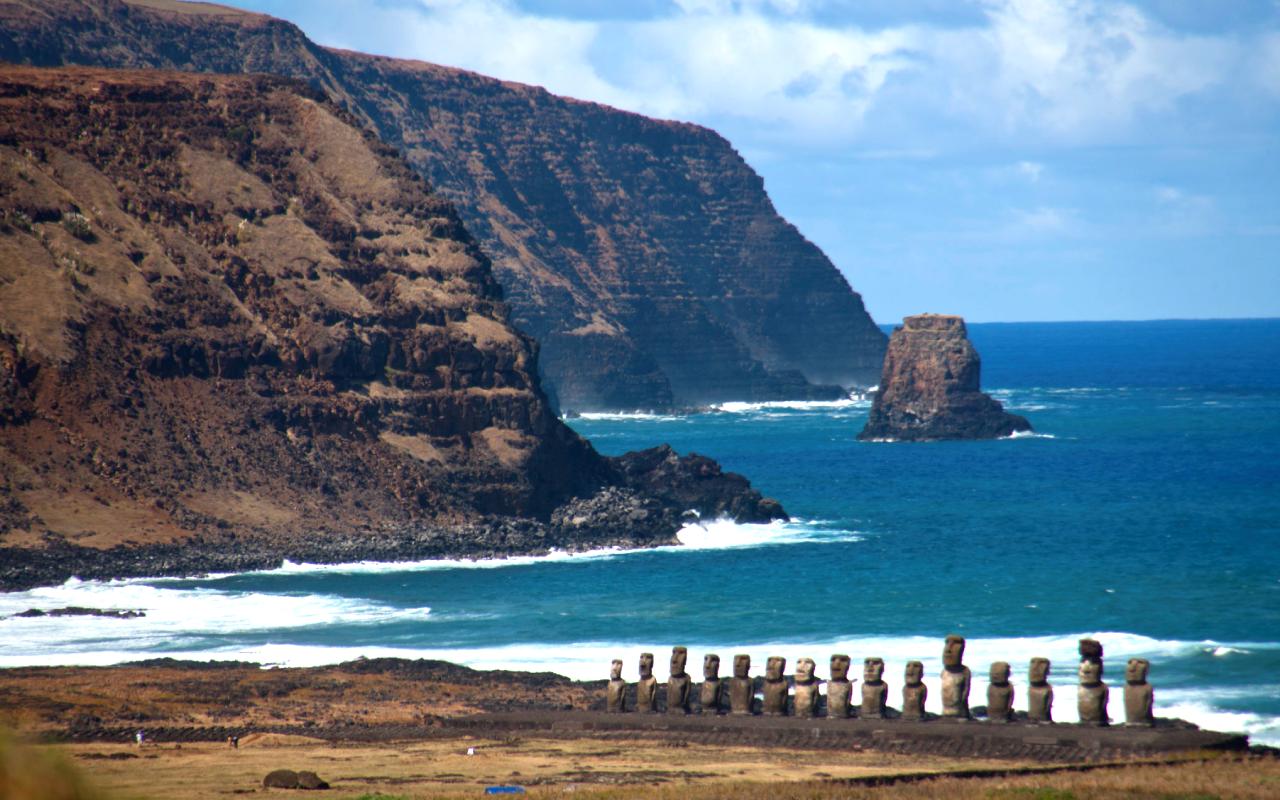
Easter Island
The history of Easter Island is full of mysteries that are enchanting the world. Tourists are fascinated to think about how the Rapa Nui came up with the idea to create the moai, how they managed to move such vast figures, and what made the society almost collapse. Although a lot has been learnt, these questions remain subject to theories and legends.
Why were the Moai built? Archaeologists feel that the moai represented the ancestors who were deified or chiefs, who lived to help the living to access the spiritual power (mana) of their ancestors. The statues are usually inland facing with a view of the village sites as though guarding the people.
The Rapa Nui thought that the presence of the statues directed protective energy and guaranteed the fertility of crops and humans. Ahu platforms with moai were therefore ritually important and a centre of clan association. The motives are somewhat speculative, although ancestor worship and rivalry between clans over pride of place were most probably significant.
How were the Moai transported? Moving multi-ton moai up to 10 meters tall across uneven terrain is one of Easter Island’s great riddles. Early guesses ranged from rolling them on logs to (outlandishly) alien intervention. Recent experiments by archaeologists Carl Lipo and Terry Hunt have revived the native legend: the moai “walked” upright.
By attaching ropes to either side of a statue’s head and rocking it back and forth, a small team of people could advance it forward in a controlled zig-zag motion. Laboratory tests with a 4.3-ton replica moai showed that 18 people could “walk” it over 300 feet in under 40 minutes.
Lipo’s research suggests many inland road moai have rounded bases and heavy, eyeless heads designed to facilitate this rocking motion. (Earlier hypotheses suggested hauling moai on sledges or countless logs, but deforestation on the island actually makes log rollers less plausible.)
What caused the Rapa Nui collapse? In the mid-20th century, the idea that the Rapa Nui wiped out their environment and society became famous (Jared Diamond’s “ecocide” theory).
Evidence shows extensive deforestation occurred; the once-tropical island lost virtually all of its native palm trees due to over-harvesting and introduced rats. Soil erosion and resource scarcity likely increased conflict among clans. However, recent studies challenge the dramatic “collapse” narrative.
New radiocarbon analysis indicates the population may have actually grown steadily until European contact in 1722, reaching perhaps 3,000–5,000 people.
It appears the true decline happened only after contact: disease, slave raids, and emigration decimated the Rapa Nui in the 19th century, rather than a self-inflicted societal crash. The debate is ongoing, but today most scholars agree the story is complex, involving both ecological stress and external factors.
Why do these mysteries attract global tourists? The questions left unanswered, and the haunting ruins evoke a feeling of wonder. Going to Easter Island is like entering an archeological detective novel: each moai poses questions about human desire, resourcefulness, and destiny.
To the traveler, the mystery itself is a great attraction; visiting the huge moai in real life enables one to reflect on the ancient engineering wonders and forgotten pasts.
Being a UNESCO World Heritage site, the natural beauty and cultural enigma of Easter Island are a distinctly chilling experience. Simply, tourists do not go to see statues, but they go to witness one of the most fascinating mysteries in history.
Easter Island Moai Statues: The Island’s Iconic Wonders
5.1 What Are the Moai Statues?
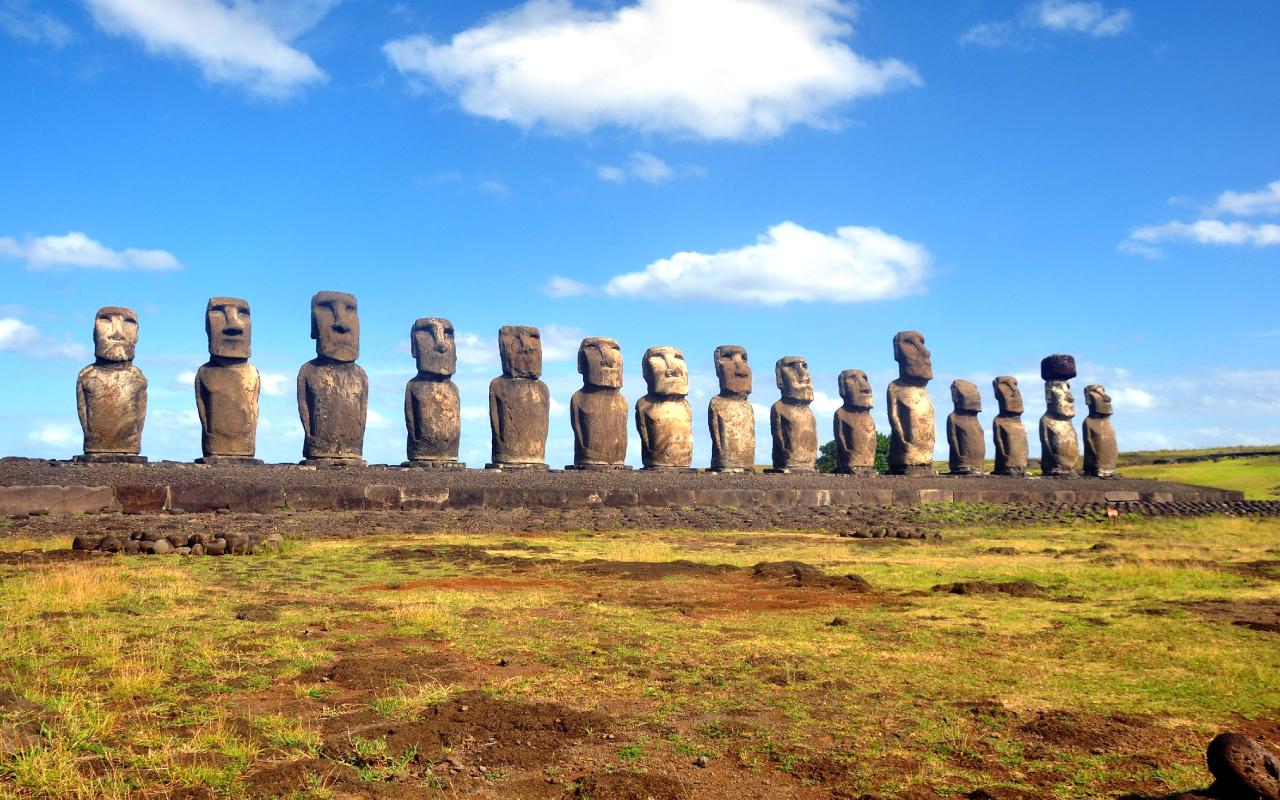
The moai are monolithic human figures carved from volcanic tuff (compressed ash) between roughly 1000 and 1600 AD. Nearly 1,000 of these statues survive across the island.
Each moai is a stylized portrait: an oversized head (usually about 3/8 of the statue’s total height), broad shoulders, and often a defined torso with hands carved on the belly. Most stand between 4 and 10 meters tall and weigh several tons; the largest (the unfinished “Paro” at Rano Raraku) would have been 21 m tall and 80 tons if completed.
Culturally, the moai are believed to represent powerful ancestors or chiefs. They were placed on rectangular ahu platforms, often at the sites of villages or ceremonial centers. The statues face inland, as if keeping watch over the people and their fields.
Legend and archaeological inference suggest the Rapa Nui thought the moai connected them with spiritual forces: their eyes were inlaid (now missing on most) to “awaken” the statue. The moai’s gaze and sheer scale embody the island’s emphasis on ancestor veneration and clan prestige.
5.2 How Were the Moai Built?
Almost every moai began life at the Rano Raraku quarry, an extinct volcanic crater whose scoriaceous (light and porous) tuff made for an ideal carving material. Rano Raraku was literally a “Moai factory”: about 95% of the island’s statues were quarried there, and hundreds of moai remain visible in various stages of completion.
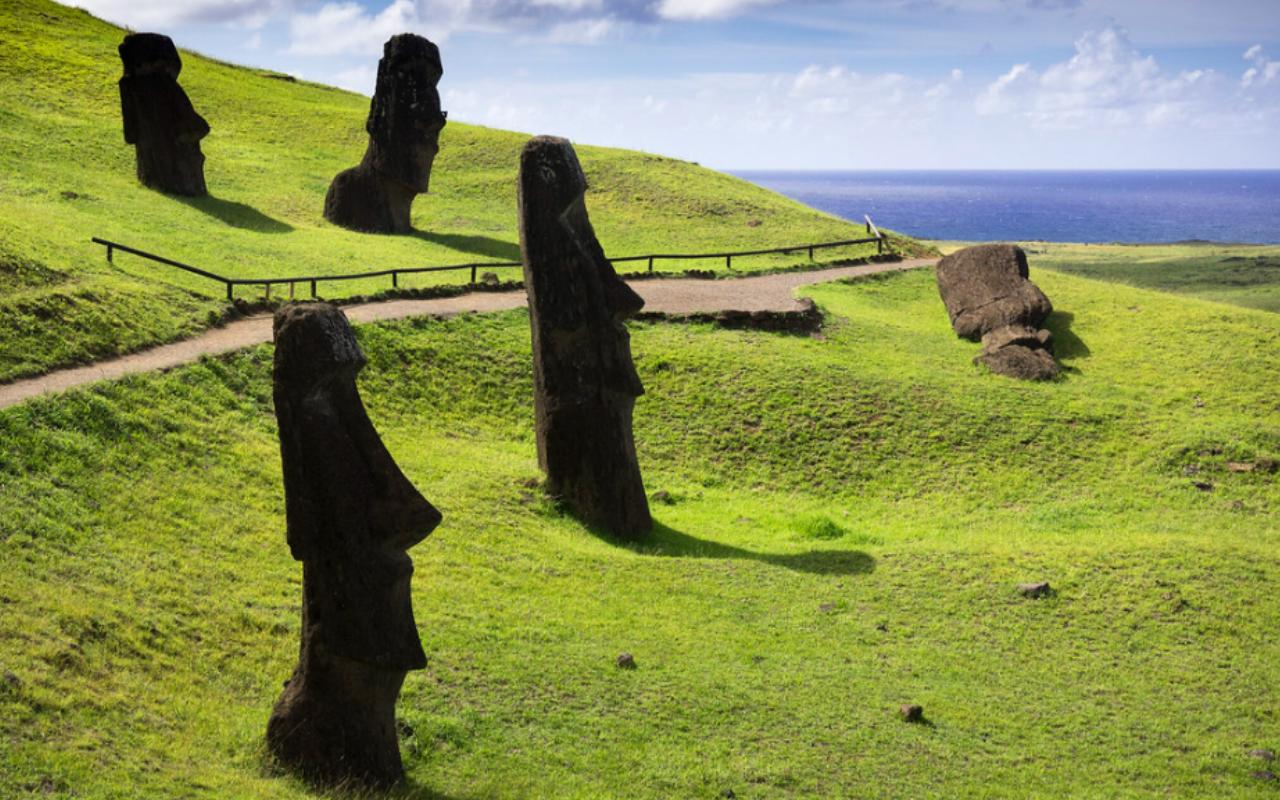
For example, tourists can walk among scores of moai heads and torsos still embedded in the quarry walls (see image below) – some merely begun, others nearly finished, and many toppled or intentionally left in place when quarrying stopped.
Moai statues in the Rano Raraku quarry. This volcanic slope was the “factory” where nearly all of Easter Island’s moai were carved.
Carvers used simple stone tools (basalt picks) to chip away the tuff. The Rano Raraku tuff was favored because it was soft near the surface, allowing sculptors to build colossal statues gradually, working from the top downward. Legends say a single clan of master carvers worked the quarry, detaching statue blanks with wooden wedges soaked in water.
The quarry’s wall face is striped with partially carved moai; one can even see the squares of stone that were removed as eyes or the upturned noses. Experimental archaeology confirms the craftsmanship: as the Easter Island travel site notes, by the end of the peak carving period, statues up to 10 m tall and 80 tons were successfully made, reflecting remarkable skill with only stone tools.
5.3 How Were the Moai Transported?
Once carved, each moai had to be moved from the quarry to its final ahu platform, sometimes kilometers away. Recent research supports the idea that the Rapa Nui “walked” the statues into place.
By attaching two ropes to the head and coordinating a team on either side, the statue could be rocked forward in a controlled swaying motion.
This was energy-efficient and surprisingly fast; experiments with a 4.35-ton test moai moved 100 meters in under a minute once it was rocking. The rounded base of the inland road moai helped them pivot, and without heavy eyes, the head remained forward-tilted to aid momentum.
Other theories, dragging on sledges or rolling on log rollers, have largely fallen out of favor, partly because Easter Island’s deforestation (historically blamed on moving moai) suggests wood was scarce.
The “walking” hypothesis fits the Rapa Nui oral tradition, which said the statues walked under spiritual power. In short, a crew of islanders could “dance” the moai across the plains with ropes, requiring far fewer resources than hauling them flat.
5.4 Famous Moai Sites to Visit
Several moai sites around Easter Island are must-see highlights:
Ahu Tongariki: The largest ceremonial platform on the island, featuring 15 restored moai in a row.
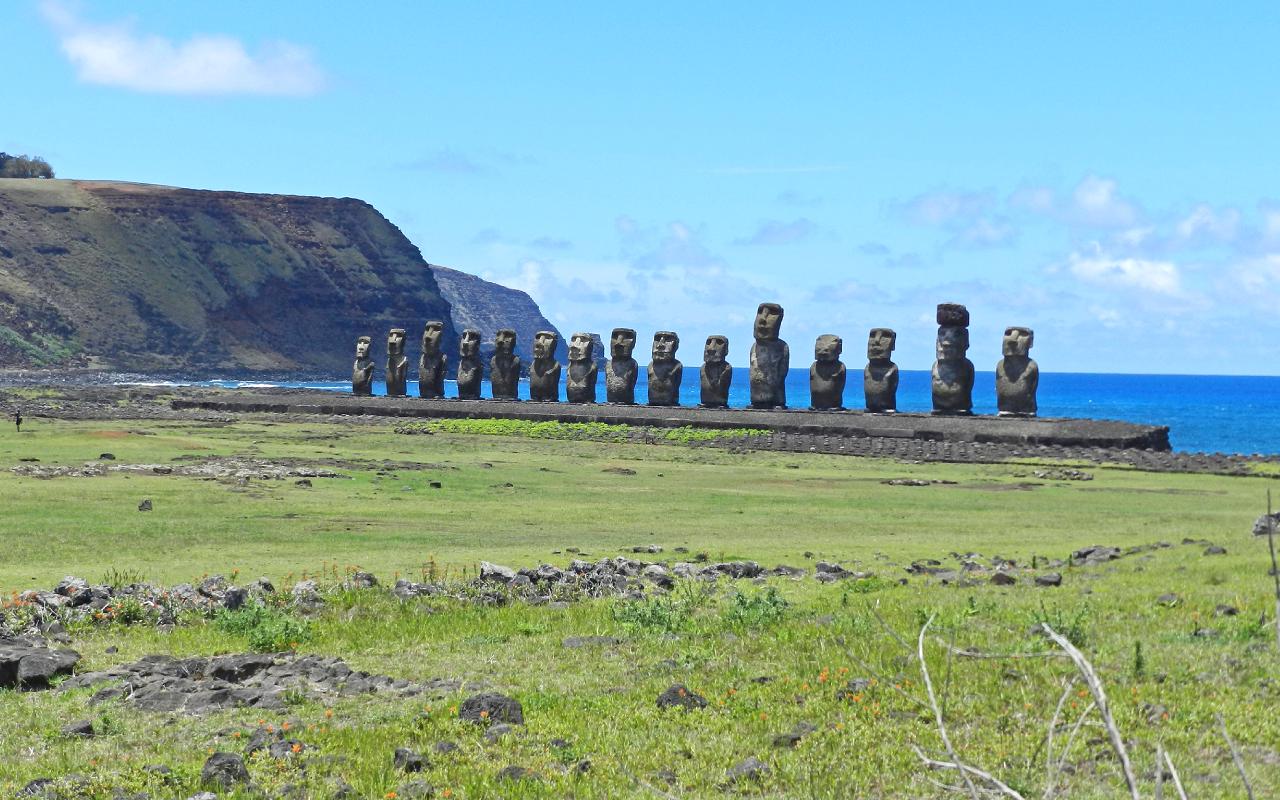
After being toppled by tribal conflict and even a 1960 tsunami, these giants were re-erected and now stand majestically against the Pacific.
Tongariki is an iconic photo spot (see image below) and is oriented toward the sunrise.
Rano Raraku Quarry: The volcanic quarry described above. Walking amid the half-finished moai at Rano Raraku is like a journey through history.
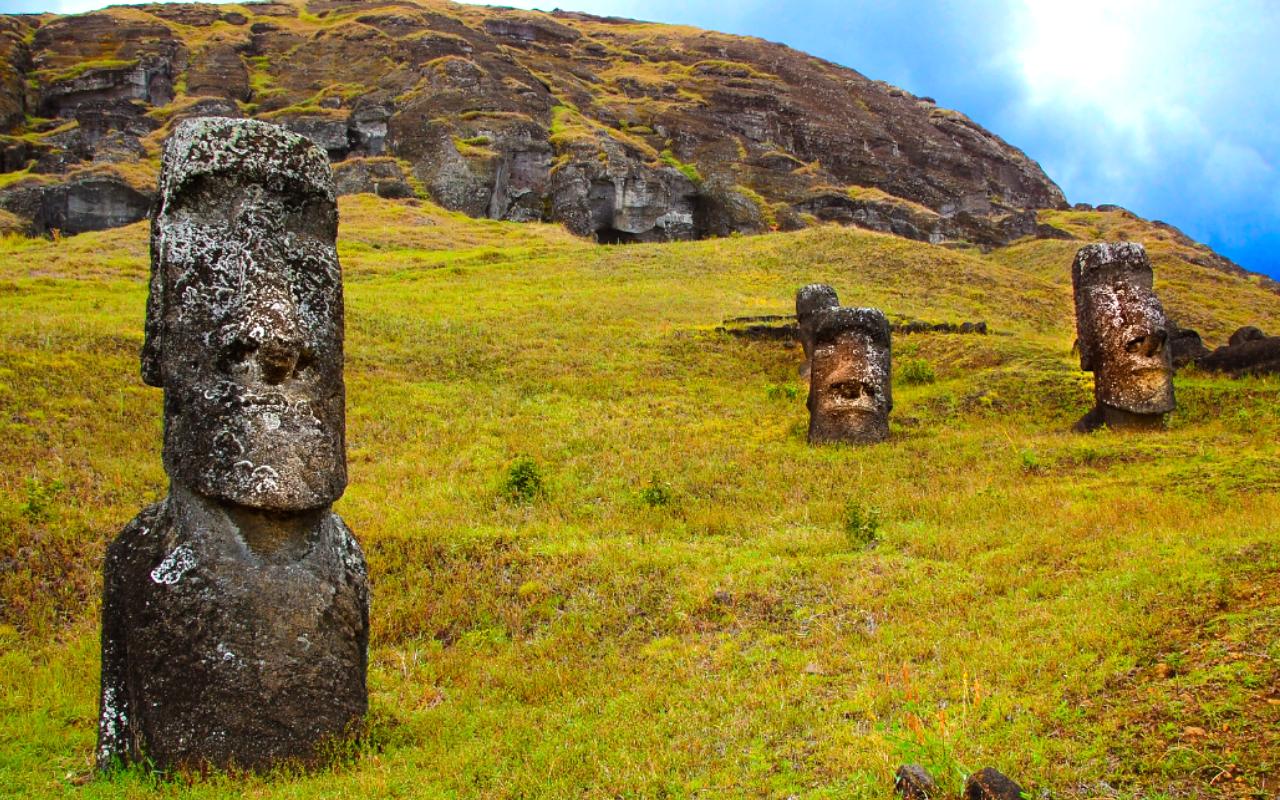
The quarry’s slope is littered with moai of all sizes, standing, kneeling, or buried to save effort, offering a glimpse of the craftsmanship (and even the occasional accidentally abandoned statue).
Ahu Akivi: An inland platform of seven moai that is unique for facing the open ocean.
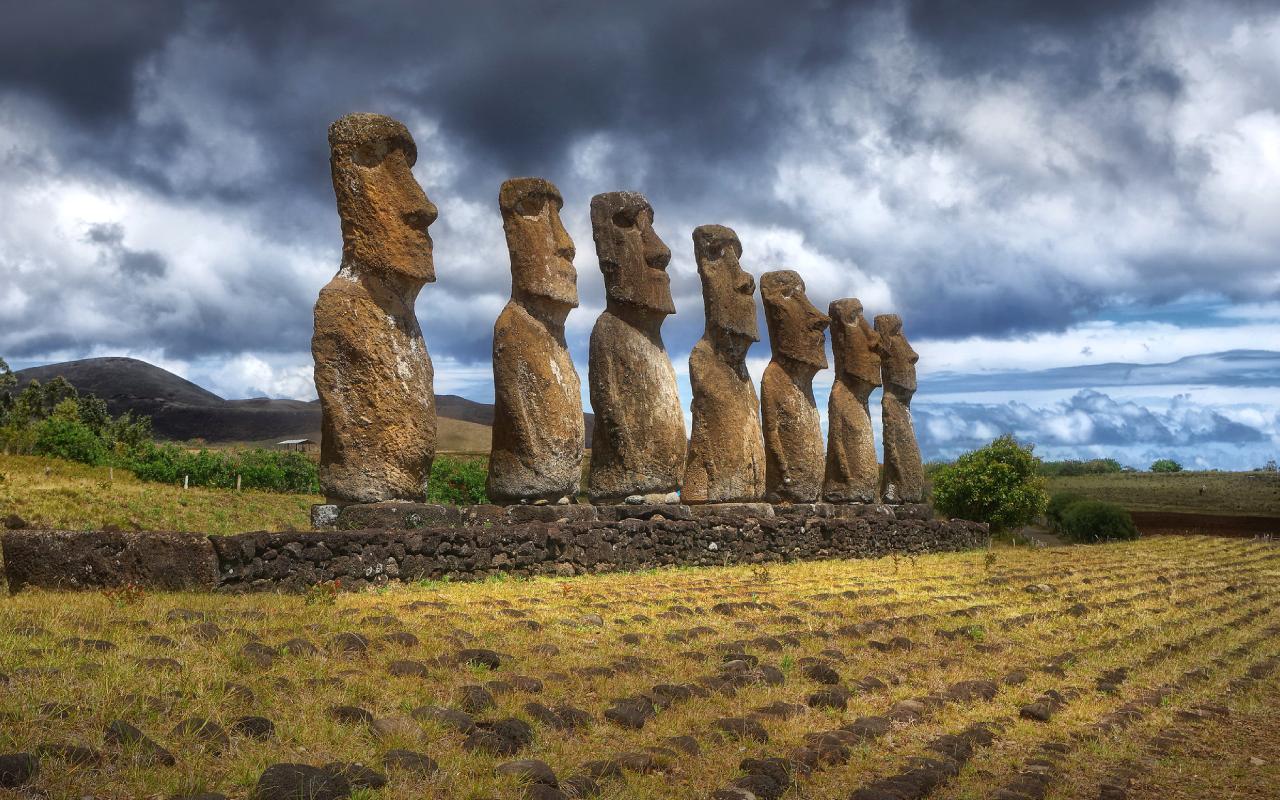
This is the only ahu where the moai look seaward; local legend even says they represent seven scouts sent by Hotu Matu’a toward the island of origin.
Unlike most coastal ahu, Akivi is inland, but its orientation surprises first-time visitors.
Other notable moai: The Tahai complex near Hanga Roa (three restored ahu), Ahu Ko Te Riku on Anakena beach (with inlaid eyes), and Vinapu (where the ahu’s stonework resembles Inca masonry). Each has its own story, and many smaller ahu with toppled or lone moai dot the island for intrepid explorers.
These sites are all within Rapa Nui National Park, which protects the moai and ahu. (A guided tour is mandatory to visit most archaeological sites.) We’ll cover Top Attractions in detail in the next section.
Top Attractions in Easter Island (Must-Visit Places)
Easter Island’s compact size means you can see many highlights in a few days. Here are the must-visit places:
6.1 Rano Raraku – The Statue Quarry
At Rano Raraku quarry, hundreds of moai are found in all stages of carving – standing, kneeling, or half-buried, in the volcanic tuff where nearly all of Easter Island’s famous statues were made.
Rano Raraku is the crown jewel of the island’s archaeology. As noted, about 400 moai lie scattered on its slopes. Walking through this “stone forest” is surreal: you might see moai only waist-high or ones sunk into the ground (the reason only their heads show above the surface).
Signposts warn not to touch these fragile statues. Rano Raraku also contains a crater lake at its summit, so a hike to the rim offers great views. Most visitors spend a couple of hours here, following the official loop trail as advised.
At Rano Raraku, you can see the true scale of the moai enterprise. Inspect the quarry to understand carving techniques: for instance, note how the statues were dug out from behind, and how pits were dug below each moai (quarry workers slid them into pits to erect them, using gravity).
Although it’s partly shaded by misty clouds in the morning, visibility is usually good, and the atmosphere is magical. This is the place where Easter Island’s intrigue is most tangible, and a guided explanation of the quarry’s history is invaluable.
6.2 Ahu Tongariki – Largest Moai Platform
Ahu Tongariki at sunrise. This restored platform holds 15 moai, the largest group on any Easter Island platform, and is considered the island’s most impressive megalithic monument.
Ahu Tongariki is the star of any Easter Island itinerary. This 100m-long altar on the east coast once held 15 colossal moai.
Today, it has been meticulously rebuilt, all 15 towering in a row. Tongariki faces the Pacific Ocean horizon, and at dawn, the rising sun illuminates the statues for a breathtaking view. (Many travelers actually schedule to watch sunrise here.) On clear days, the South American mountains can be faintly seen on the horizon far away.
Visiting Tongariki gives insights into Rapa Nui beliefs. According to tradition, Tongariki was a major center of a clan named Hotu Iti; legends about sorcery and tribal wars are tied to this site.
In 1960, a Pacific tsunami knocked the moai into the bay; they were later re-erected by archaeologists (notably William Mulloy in the 1990s). Today, the site is accessible via a dirt road (normally as part of a guided loop tour with Rano Raraku).
If time allows, explore the surrounding flatlands, which hold petroglyphs and the remnants of stone-hut foundations from ancient villages. A visit here is both awe-inspiring and humbling; one stands among the largest man-made monoliths of Polynesia.
6.3 Rano Kau & Orongo Village
The crater lake of Rano Kau volcano (with Orongo on the rim). Rano Kau’s nearly complete rim features steep cliffs and a freshwater crater lake, while Orongo, a stone village, lies on the western edge of the crater.
Rano Kau is one of the three extinct volcanoes on Easter Island (western corner). Its broad crater holds a freshwater lake formed by rainwater, visible from the village of Orongo on the rim.
The Orongo settlement (9th–15th century) was the ceremonial center of the Tangata Manu (Birdman) cult. Pilgrims would climb here each summer solstice to compete in a dangerous bird-egg race from the islet of Motu Nui. Today, Orongo’s restored stone houses (with their distinctive leaning walls) display many birdman and ethereal petroglyphs carved into stone tablets.
Visiting Rano Kau means hiking up from the coast along rough paths. The scenery suddenly opens up to a 300m cliff plunging into the Pacific. Once atop, one can walk the rim (weather permitting) for panoramic views. On clear days, you may glimpse Motu Nui and the ocean. The crater lake below is also emerald green and photogenic.
Orongo village itself is composed of several dozen house foundations. An information plaque explains the Birdman ritual: each clan sent a champion (hopu) to swim out and retrieve the first manutara egg from Motu Nui, then return up the cliff.
The winner’s clan chief was declared Birdman for the year. The petroglyphs here depict birds and humans, and their meaning has intrigued researchers for decades. Note: Orongo and Rano Kau are accessed via a path from the southeast road (near the crater edge); it’s advisable to have a guide to fully appreciate the carvings and history.
6.4 Anakena Beach – White Sand Paradise
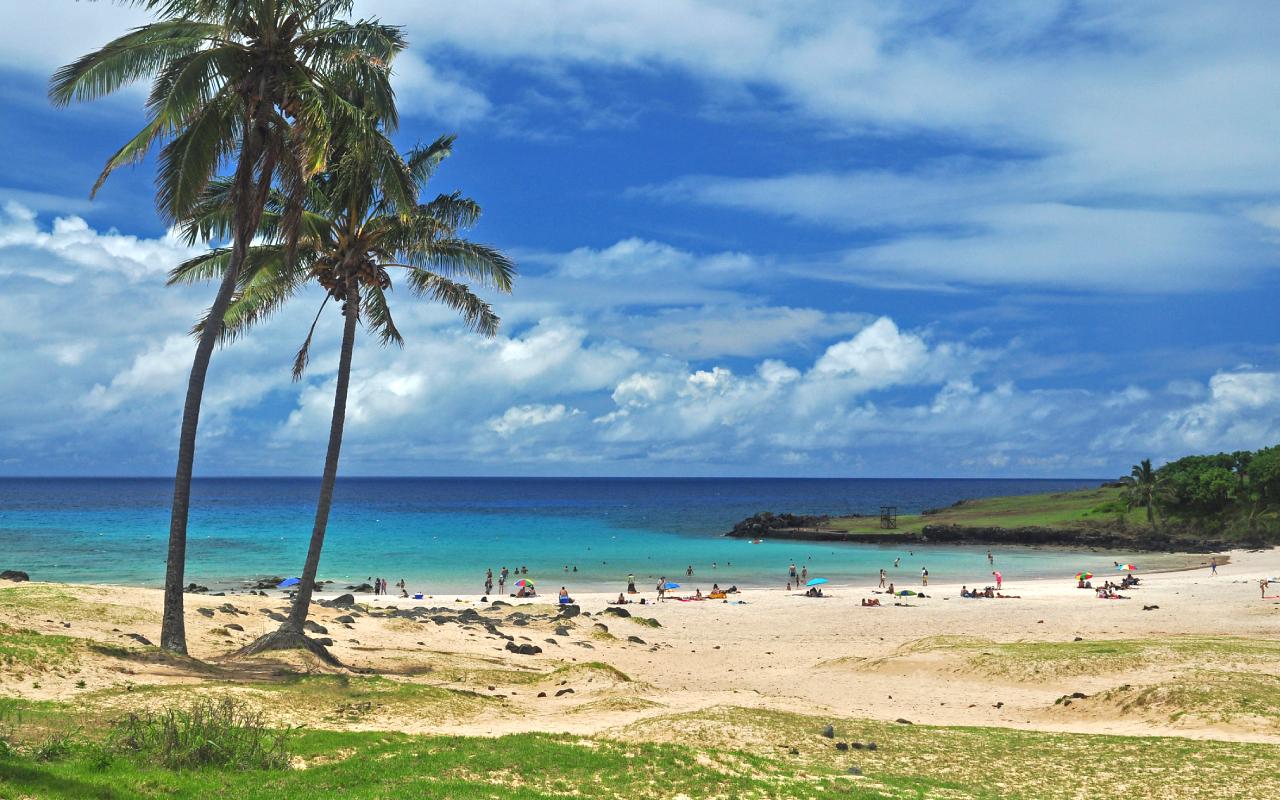
Anakena Beach. The white sandy shore and palm trees here contrast sharply with the rest of Easter Island’s rugged lava landscape. At one end of the beach stand seven moai on their restored ahu (Ahu Nau Nau), the first statues erected by King Hotu Matu’a according to legend.
Anakena is the island’s most famous beach: a turquoise cove with a stretch of soft white coral sand and a few tropical palms. It’s said to be the landing place of Hotu Matu’a, the legendary first settler of Easter Island. For this reason, Anakena holds a special place in Rapa Nui lore.
Today, the beach is a relaxing stop. You can swim, snorkel in the calm bay, or picnic under the shade of coconut palms. A short stroll north from the beach brings you to Ahu Nau Nau, where a restored row of seven moai gazes inland.
(Four of them even have red pukao topknots.) The view is tranquil: moai and palm trees against the blue sea. Many visitors linger here to watch the sunset behind the palms or enjoy the clear evening light on the statues.
On the way to Anakena, you’ll pass Puna Pau, the quarry of red scoria where the moai pukao (hats) were carved. A walk up the low hill at Puna Pau reveals unfinished pukaos (red stone cylinders) waiting to be put atop moai. This little side visit is quick but rewarding for volcanic enthusiasts.
Anakena’s combination of beach fun and history makes it a must-stop. It is somewhat removed (about a 30-minute drive from Hanga Roa via Poike), so plan accordingly. Entry to the archaeological part of Anakena requires the park ticket, but you can freely use the beach area.
6.5 Puna Pau – Red Stone Quarry
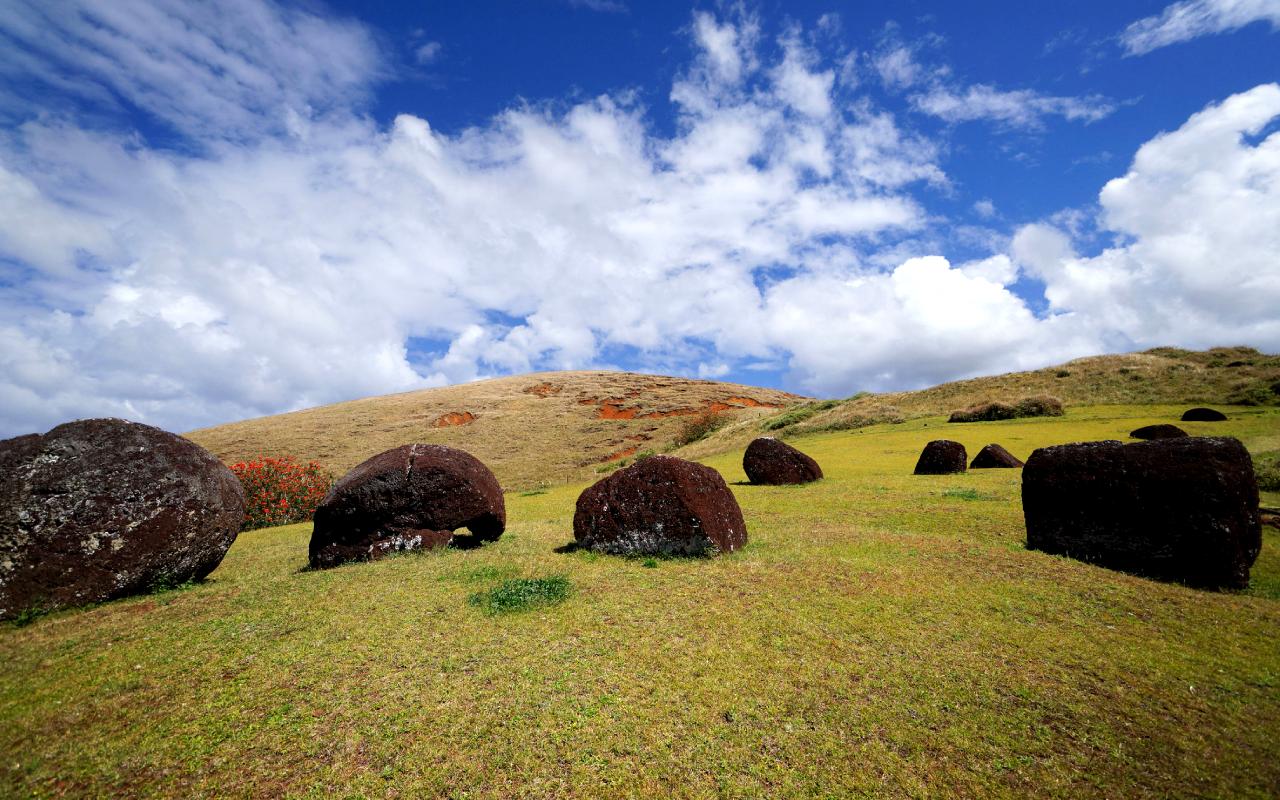
Puna Pau is the small red volcanic crater (inland, just outside Hanga Roa) where the topknots were carved. On Easter Island’s temples (ahu), some moai wear round cylinders of red volcanic rock (called pukao).
These are believed to represent topknots of hair or helmets. At Puna Pau, you can climb a short trail that leads to a quarry where many pumice blocks were cut.
You’ll see a partially carved pukao lying on its side, roughly two meters long. The soil here is red and has small fragments of the light red rock scattered around. It’s a quick stop to see the source of those colorful hats you see on statues, like at Tahai or Hanga Nui.
Easter Island Culture: Traditions of the Rapa Nui People
Easter Island’s living culture is as rich as its archaeological legacy. The Rapa Nui people are Polynesians, linguistically linked to Tahiti, Hawaiʻi, and New Zealand. Today, their identity is proudly preserved through language, dance, and festivals.
Language and Identity: Rapa Nui (or Rapanui) is a Polynesian language that is still used by a number of islanders. Rapa Nui is also taught in schools on the island as a way of preserving the heritage. Spanish is also an official language.
The mixed Polynesian and Chilean backgrounds of most of the islanders continue to date back to the present, though the Rapa Nui language and customs are still vibrant in everyday life.
Dance, Music, and Festivals: Traditional dance and music thrive. Local groups perform sau-sau (a circular dance with rhythmic chants), hara hapi (similar to a hula), and tama hunt (percussion and chants), often at cultural shows in Hanga Roa.
Dances usually involve ukulele, hand drums, and vocal chanting. One of the highlights of Rapa Nui culture is the Tapati Rapa Nui Festival (in early February each year).
Tapati is a week-long celebration of traditional sports, music, dance, crafts, and a beauty pageant. Tribal teams compete in ancestral games: canoe racing (vaka ama), re-enacted birdman contests, egg-and-spoon races, and even the famous Haka Pei (extreme downhill slide on banana logs). Tapati is a colorful outburst of island pride and attracts huge masses throughout Polynesia.
Ancestor Worship and Beliefs: Rapa Nui religious traditions have always focused on the worship of ancestors and nature. The moai themselves exemplify this; ancestor spirits (called akua or ariki) were believed to inhabit the statues.
Many archaeological sites have associated petroglyphs or shrines. One famous sacred stone is the Te Pito o Te Henua (“Navel of the World”), a cave boulder said to embody the power of the first king.
Rapa Nui folklore also includes creation myths (Hotu Matu’a’s voyage) and ghost stories about caves. While most Rapa Nui today are Christian (mostly Catholic), many still honor ancestral traditions and mix them with faith practices.
The island’s spiritual heritage lives on in local festivals and rituals, such as Easter church celebrations and offerings (umu tahu) that include traditional foods like curanto (a pit-roast of seafood and meat).
Modern Preservation: In recent decades, there has been a conscious effort to revive and preserve Rapa Nui culture. Local groups teach traditional carving, woodwork (rapa paddles), and tattooing patterns.
The Rapa Nui National Park is co-managed by the indigenous community (Ma’u Henua). Museums in Hanga Roa display rongorongo tablets (the undeciphered script) and artifacts.
Younger generations participate in cultural workshops, and tourism has actually helped fund schools that teach the Rapa Nui language and art. As the island’s population has grown (over 7,000 today), cultural festivals and sports remain a unifying force.
Easter Island Tourism: What to Expect Today
Visiting Easter Island is not like going to a major city or resort; it’s a remote, lightly developed destination. Here’s what travelers should know:
Getting Around: The island has about 176 km of paved road looping around the coastline. Rental cars, scooters, and bicycles are available in Hanga Roa. There are a few local buses (collectivos) that run west to Anakena and south to Orongo. Taxis and ride-share services are very limited; if you need a lift, ask at your hotel or join an organized tour. Driving is on the right (as in Chile). Most attractions are accessed via the main ring road, but some require short hikes (e.g., Orongo).
Entry Rules & Park Fees: Nearly all archaeological sites are within Rapa Nui National Park (which covers 43% of the island). Entrance to the park is mandatory for visitors and costs about 95,000 CLP (USD 100) per foreign adult (tickets valid 10 days).
Importantly, since 2022, it is required to be accompanied by an accredited guide or Rapa Nui host over age 18 to enter park sites, except for Tahai and Anakena beach.
This means many tours or hotel excursions will include a guide by regulation. Tickets can be purchased online in advance or in person in Hanga Roa. Even for short stays, you must budget this fee.
Tourism Infrastructure: Hanga Roa is the only town; it has hotels (ranging from small guesthouses to a few luxury lodges), restaurants, a bank (ATMs), shops, and a Sunday handicraft market. Outside Hanga Roa, there are no services except at the larger hotels.
Electricity and water are available (though fresh water is limited; don’t waste it). Internet and cell service exist but can be spotty; many websites and guides suggest downloading maps and info before arrival.
With only one airport and a small population, everything on the island (food, fuel, supplies) is costly. Plan to pay extra for basics: groceries and gasoline are more expensive than on the mainland. Bringing some cash (Pesos) is useful, although most shops and tour operators accept credit cards.
Sustainable Tourism: The local government and tourism board emphasize “tourism with identity”. Since the 2020 pandemic, the island has intentionally limited flights and hotel expansion to avoid overtourism. Travel authorities strongly encourage visitors to respect sites: no climbing on ahu, no taking rocks or shells, and always following marked paths.
Guides will stress “leave no trace” principles. Some islanders even offer environmental volunteer excursions (e.g., beach cleanups or reforestation) for interested travelers. The islanders’ own perspective is that tourism should serve their community; in recent years, local leaders have questioned whether more flights or hotels are “responsible”.
Guided vs. Independent: You can explore some areas on your own, but guided tours are very common and often necessary. Many visitors take multi-day tour packages or rent 4×4 vehicles with guides. However, if you are adventurous, it’s possible to see many sights by self-driving or biking (just note the no-guide rule). There are also boat trips around the islets and snorkeling tours.
Whatever you choose, advanced booking is recommended due to limited options.
Travelers should enter with an open mind: this is an archaeological preserve as much as a tourist spot. Expect tranquil nights under stars (no light pollution), friendly locals, and a strong sense of history at every turn.
Cited facts: Park entry and guide rules; pre-pandemic visitor count; sustainability emphasis.
Easter Island Facts: Surprising Things You Didn’t Know
Isolation: Easter Island is over 3,500 km from Chile and about 2,075 km from Pitcairn Island, making it one of the world’s most remote inhabited islands.
Moai Count: There are roughly 887 moai scattered around Rapa Nui today (with hundreds more fragments). Nearly 400 sit at Rano Raraku alone.
No Rivers: There are no permanent rivers or streams; the island’s porous volcanic soil drains rain immediately into the ground. Fresh water comes from the crater lake in Rano Aroi, springs, and wells.
World Heritage: In 1995, UNESCO declared Rapa Nui National Park a World Heritage site for its outstanding archaeological legacy.
Rongorongo Script: Easter Island developed an undeciphered hieroglyphic writing system called Rongorongo. Only about 25 wooden tablets survive today. No one has fully cracked the code, so the island’s own written secrets remain unknown.
Festival Time: The best-known festival is Tapati Rapa Nui in early February, when the population swells with visitors for a two-week celebration of dance, sport, and culture.
Internet Access: There is internet and mobile phone coverage on the island, but it is limited and often slow. Do not expect high-speed Wi-Fi everywhere; many visitors find themselves off the grid at archaeological sites.
Black Sand & Coral Beaches: Besides the famous white-sand Anakena, there are black-pebble beaches (like Puna Pau), and small coral sand coves (like Ovahe Beach) for more secluded visits.
Island Cuisine: Traditional Rapa Nui dishes include ceviche de pescado (fresh raw fish) and the curanto pit barbecue. “Mana Salinas” sea salt farm produces a local pink salt, a nice souvenir.
Unique Flora: The only native palm (Paschalococos disperta) is extinct. Today, the island has mostly introduced plants (eucalyptus, palm trees in Anakena). As a result, it looks drier than its primeval forest past.
Easter Island Secrets: Hidden Gems & Lesser-Known Spots
Beyond the famous ahu and parks, Easter Island has many hidden treasures waiting to be discovered:
Secret Caves: The island has an extensive network of lava tubes and caves – over 800 cataloged, and likely more. Some served as shelters, manioc pits, or legendary sites.
Notable caves include Ana Kakenga (a tiny, narrow hole on the coast that requires crawling in) and Ana Te Pahu (a collapsed lava tube now open to the sky, used as a natural greenhouse where old Rapa Nui planted crops).
These caves often connect to family histories and myths; for example, children born in caves consider it auspicious. Visitors with guides sometimes explore short, easy caves to experience this secret underground world.
Lost Petroglyphs & Petroglyph Sites: Beyond the widely seen carvings, there are dozens of lesser-known rock art sites off the beaten path. For instance, faded petroglyphs can be found near the coast (a boatman engraved his boat on lava rock at El Gendarme by the water).
The Ahu Akahanga site has petroglyphs telling clan stories. Local guides can show visitors secluded carvings that aren’t in guidebooks, often found on stray hikes or hidden by brush.
Hidden Moai: Some ahu are completely off the tourist track. For example, Hanga Kio’e in the northwest has three small, weathered moai on a platform; you might find them unexpectedly during a loop drive.
Ahu Huri A Urenga (near the airstrip) is unique: it holds a moai with two sets of hands carved on its belly (no one knows why!). Ta’uanna has a fallen moai with intricate eye sockets. Exploring by foot or bike can yield these small discoveries that feel like your own Easter Island “find.”
Local Viewpoints: While Tongariki sunrise and Tahai sunset are famous, there are other fantastic outlooks. Try sunrise at Anakena beach (behind the statuary) or sunset at Orongo crater’s rim overlooking the western horizon.
From the slopes of Terevaka (the highest point), you can hike through scrub and see 360° of the island below, great for photography or solitude. Another cool perspective is from a tour boat around Motu Nui (the islet of the birdman ritual): from the water, you see Rano Kau’s full cliff face in relief.
Family Legends: Many families on Rapa Nui still share oral histories of secret caves and treasures. Early anthropologists (like Katherine Routledge and Thor Heyerdahl) wrote of hidden troves of obsidian or rongorongo tablets, typically lost to history.
Even today, older residents know stories of a few family-owned “hidden caves” that might contain old tools or heirlooms, their locations whispered only to heirs. These personal heritage sites are respectfully off-limits to tourists, but they contribute to the island’s aura of intrigue.
Underwater Secrets: Don’t overlook the coast, tidepools at Motu Iti or Ahu Naunau hide sea life, and snorkeling off Anakena or Hanga Roa can reveal colorful fish and black coral. Shipwrecks near the shore and submerged ceremonial platforms (like Tahai’s sunken altar) are sometimes visible to divers.
These hidden gems reward the curious traveler who ventures beyond the main trails. The Rapa Nui culture is very conscious of its sacred nature; always ask permission before entering any cave or private land, and treat these lesser-known spots with respect.
What Happened When Easter Island “Burned”? (Environmental Collapse Story)
For decades, Easter Island was held up as a cautionary tale of environmental collapse. The narrative went: the Rapa Nui over-exploited their resources (felling all the palms to move moai, etc.), causing soil erosion, crop failures, and ultimately societal collapse. Let’s unpack that:
Deforestation and Ecological Destruction: First explorers wrote that there were no trees on the island; they only saw shrubs and grasses.
Scientific research confirms extreme deforestation occurred: a unique native palm (Paschalococos disperta) and other trees were wiped out. Causes likely included wood for moving moai and building houses, combined with rats (which ate palm nuts) and fires.
The disappearance of the forest, loss of topsoil, and the ecosystem became delicate. Crops may have been reduced, and birds and other food sources may have been reduced. This serious environmental stress is undisputed.
Population and Society: Diamond’s popular book “Collapse” argued that this ecological disaster led to warfare, cannibalism, and ruin. However, more recent evidence suggests Rapa Nui society adapted in some ways.
For example, they built stone “manavai” garden enclosures to protect plants. The literal “burning” (wildfire) story is part myth: volcanic eruptions burned parts of the landscape, and deliberate slash-and-burn may have been used historically, but there’s no giant inferno that annihilated the island in one go.
Myth vs. Reality: While the environment certainly deteriorated, newer studies of the island’s timeline argue population stayed relatively low (a few thousand) and grew until Europeans arrived.
In other words, there was no sudden collapse before contact. The catastrophic decline happened later, due to outside forces (disease, slavery). So the “burning” story is more allegory than fact. That said, lessons remain: Easter Island’s history underlines how remote societies must manage resources wisely.
Modern Perspective: In the current times, following the reforestation, a few palm seeds have been planted experimentally. Islanders often speak of this ecological legacy as a warning.
The local government now actively protects the fragile landscape: tourists must stay on trails, introduce no invasive species, and water conservation is practiced. So in a way, the story of “Easter Island burning” has come full circle as inspiration for sustainability in the 21st century.
Flights to Easter Island: How to Get There
Its isolation means flying in is the only practical way. Most regular commercial flights operate via Santiago, Chile (SCL). The main carrier is LATAM Airlines, which operates year-round flights to Mataveri International Airport (IPC).
The non-stop flight from Santiago to Easter Island takes about 5.5 hours. Before the pandemic, there were up to 10 flights per week, but as of 2026, airlines have resumed with fewer frequencies (a few flights per week, increasing seasonally). Private charters or cruise ships also occasionally visit.
For international travelers, the typical route is via Santiago. Some LATAM flights connect onward from major cities like Miami or New York (with a stop in Santiago); the total travel time from the US can range from 15–19 hours depending on connections. LATAM’s website advertises one-stop itineraries for about USD 1,300–1,400 round-trip from Santiago (off-season) to Easter Island.
Fares vary widely by season; high demand (e.g., around February Tapati) can push prices higher, so booking 6+ months ahead is recommended if possible. Charter flights (for tour groups) sometimes come via Tahiti or other Pacific points, but these are sporadic and need advance arrangement.
In 2026, LATAM is currently the only scheduled airline; previously, LAN Chile (now part of LATAM) had flights. There are occasional Air Tahiti Nui charters (from Papeete, Tahiti) advertised in late 2026, but these are special and limited.
Important: plan your flights well in advance (international and domestic), as the route is busy and seats can fill up. Check LATAM’s site for current schedules and fares – for example, flights from Santiago in mid-2026 show one-week round-trip prices starting around USD 1,365.
If traveling from outside Chile, remember to allow time for the Santiago-Easter Island connection. It is also wise to arrive in Santiago a day before, in case of delays (weather in the Andes can occasionally disrupt flights). The long flight over the Pacific is comfortable, but be sure to bring any necessary in-flight entertainment (there is usually a screen on LATAM flights).
Once landed, you’ll walk down a short jetway into a simple airport terminal. Officially, only ticketed airline passengers can enter the airport. Customs are minimal (you’ll just show your entry permit if visiting Chile, and declare any agricultural items, etc.).
Best Time to Visit Easter Island
Because of its mild oceanic climate, there is no single “bad” season, but your experience will vary with the weather and crowds. Summers (December–March) are warm (highs 27–28°C) and coincide with holidays and the Tapati festival in February.
This is the high season, ideal for beaches and lively cultural events, but expect more tourists and higher prices. Rain can fall at any time, but summer is slightly wetter (especially January and May are among the rainiest months).
Shoulder seasons offer a sweet spot. April–May and September–October typically have mild temperatures in the low to mid 20s°C and fewer crowds. The guidebook weather site notes that April–May and September–October are excellent: mild weather, fewer tourists, and a relaxed atmosphere.
These times are great for hiking and photography: the landscape is still green (after summer rains), and the sun angle is softer. Evenings can be cool (down to 16°C in winter), so a light jacket is recommended.
Winter (June–August) is cooler (highs around 20–22°C) and windier, with more rain. It’s off-season, so many tours and some restaurants operate on shorter hours, but you’ll have the island to yourself. Some locals say that Easter Island feels coziest in winter (with eucalyptuses smelling in the air). For travel deals, June–August can offer lower rates on accommodation.
Note: The Tapati Rapa Nui festival is held each year in the first half of February. If you want to experience this unique cultural event (parades, music, races), plan to be on-island in late January/early February. However, book months in advance, hotels can sell out.
In summary, peak culture and warm weather: Dec–Mar (especially Feb for Tapati). Low crowds and mild weather: Apr–May, Sep–Oct. Cool quiet season: Jun–Aug. Any time is beautiful with proper planning – just bring sun protection (hat, sunscreen) and a light rain jacket.
Travel Tips for Visiting Easter Island
Permits and Fees: Book your Rapa Nui National Park ticket online before arrival or immediately on arrival. It costs about CLP95,000 for foreigners. Carry a printout or digital copy of your ticket. Guides are required on-site (except Anakena/Tahai), so arrange any self-drive stops around these regulations.
Packing Essentials: Sun protection is essential: pack a broad-brimmed hat, sunglasses, and high-SPF sunscreen. Footwear should be sturdy for rocky trails (especially if hiking to Rano Kau or Terevaka). A windbreaker or light jacket is useful even in summer, as it can be breezy. If visiting in winter or early morning, layers are advisable. The weather can change quickly, so be prepared for sun, rain, and wind in one day.
Money and Costs: Easter Island is expensive. ATMs are available in Hanga Roa (Chile’s Pesos). Credit cards work at most hotels, restaurants, and tours; still, carry some cash for small purchases at markets. Tipping is appreciated but not mandatory (10% in restaurants).
Food & Water: Restaurant meals in Hanga Roa run $15–30 USD per person. There are a couple of grocery stores; consider buying snacks or supplies, as food off-island is pricey. Tap water is generally safe to drink, though many locals prefer bottled water. Eating local specialties (fresh fish ceviche, banana-covered desserts, curanto pit-roast) is highly recommended!
Safety: Easter Island is very safe (no big cities or crime waves). You can walk around Hanga Roa at night without worry. The main hazards are natural: sunburn, dehydration, and the ocean waves. Don’t climb on the ahu or moai; it is illegal and dangerous. Stay behind barriers at cliff edges (Rano Kau crater has sheer drops).
Local Customs: Rapa Nui people are friendly but proud of their culture. Greet people with “Iorana” (hello) to make a good impression. Show respect at sites: do not touch or move artifacts or rocks. If entering any sacred site, do so quietly. Always ask before taking someone’s photo. Many sites have local guides or signage in Spanish and English; read the information to appreciate the history.
Connectivity: Expect intermittent internet. Download maps and translations in advance (Wi-Fi in cafes can be slow). SIM cards can be purchased at the airport (Claro and Entel networks), and the speed of data might be low.
Environmental Care: The ecosystem of the island is sensitive. Do not litter; carry out all your trash. Use only established trails. Avoid using freshwater beaches or lagoons as sandboxes for young children (the water table is a drinking source). Consider a reusable water bottle to reduce waste.
These tips will help you navigate the unique challenges of Easter Island travel. Remember: planning ahead (accommodations, park tickets, tours) is key because of limited services and high demand for this remote destination.
Sample 3–5 Day Easter Island Itinerary
Here’s a suggested itinerary outline. Adjust according to your interests and pace:
Day 1: Arrival & Sunset – Fly into Mataveri airport, pick up a rental car. Spend your first afternoon exploring Hanga Roa (visit the local museum or walk to the Tahai ahu complex for sunset). Enjoy your first view of moai silhouettes with the Pacific sunset in the background.
Day 2: Quarry & Ahu Exploration – Start early at Rano Raraku statue quarry (fewer crowds). Then drive to Ahu Tongariki – plan to see sunrise or late afternoon here if possible. Afterward, stop at the lonely Ahu Akivi inland platform. Optional: as you return, go to Vinapu to see its accuracy stonework and solitary moai head.
Day 3: Volcanoes & Villages –Drive south to Rano Kau crater and Orongo village. Investigate the Birdman stone village and take a stroll around the rim. In the afternoon, visit Anakena Beach, lie on the sand, swim, and visit the Ahu Nau Nau moai. Catch sunset on the beach if time allows.
Day 4: Hidden Gems & Culture – Dedicate a half-day to “off-the-beaten-path” spots: e.g., the eastern Ana Te Pahu cave or Hanga Poukura. Explore any nearby petroglyph sites. In the afternoon, attend a Rapa Nui cultural show (songs/dance) in Hanga Roa and visit the artisan market.
Day 5 (Optional): Leisure & Last Stops – Use this day for anything missed. You might hike to the top of Mt. Terevaka (requires a guide), or take a manta ray snorkeling trip. Or simply relax in the village, do some souvenir shopping, and say farewell with a sunset at Tahai or Anakena.
Each day’s activities can be modified. The island is small, so driving times are short (most spots are 20–40 minutes from Hanga Roa). Allow extra time for photography and rest; the sun can be intense, and the island vibe is very laid-back.
Budget Guide: Cost of Traveling to Easter Island
Easter Island is a costly destination due to its remoteness. Below is a rough budget breakdown:
Flights: From Santiago, expect $1,000–$1,500 USD round-trip per person. (Booking months in advance can sometimes lower fares.) For example, summer economy fares listed on LATAM start around USD 1,365.
Accommodation: Prices range widely. Budget hostels or guesthouses can be found for $50–$80 per night (for a private double room) in low season. Mid-range hotels run $120–$200 per night. Upscale lodges or boutique hotels often exceed $300/night. (TripAdvisor data suggest high-season averages can be as high as $600/night.)
Food: Meals tend to be pricier than on the mainland. A typical lunch or dinner at a local restaurant will cost around $15–$30 per person (entrée plus drink). Cheaper options (sandwich shops, pizza) are around $10–$15. Groceries in Hanga Roa are about 50% more expensive than in mainland Chile. Budget $30–$50 per day per person for food.
Tours & Transportation: Renting a car is $50–$70/day. Guided day tours (half-day or full-day) range from $50–$100 per person, depending on duration and inclusions. National Park entry fee is 100 USD (see above). Boat excursions or cultural performances may cost $40–$80 extra.
Miscellaneous: Souvenirs (carvings, shells, honey) can add up; a small handcrafted item is $20–$40. It is common to tip 10-15 percent in case of good service.
Money-Saving Tips: Book a hotel and Flights in advance. See shoulder seasons (April-May or Sep-Oct) to get reduced hotel charges. Cooking at your accommodation (some hostels have kitchens) can reduce food costs. Walking or biking shorter distances saves on fuel. Most importantly, buy your park ticket online in advance (avoid on-the-spot price hikes) and plan your visits to maximize each entry’s value.
In short, budget travelers should plan on spending at least $200–$300 USD per day (per couple) for a modest trip; mid-range is $300–$500/day; high-end luxury easily goes above $500/day. Easter Island is an investment in once-in-a-lifetime experiences, so budget accordingly.
Why Easter Island Should Be on Your Bucket List
Easter Island offers a truly once-in-a-lifetime experience. It is a blend of history, mystery, and natural beauty like no other. Here are the reasons why you should visit:
Unrivalled Archaeology: A visit to hundreds of mysterious moai is breathtaking. The likes of these monolithic ancestor statues are not found elsewhere. Through the great row at Tongariki up to the terrifying heads at Rano Raraku, they fascinate the imagination.
Distinct Culture: Rapa Nui is a colorful culture that is not common. The language, dances, and festivals you will experience are such that you will hardly find their equivalents in the world. The Tapati festival and other events that are held in the area give a profound understanding of ancient Polynesian practices.
Stunning Views: The landscape of the island – volcanic cones, huge plains, blue ocean – is unearthly. The mixture of tropical beaches (Anakena) and rough terrain (Rano Kau cliff) on a small Island can hardly be found elsewhere.
Sense of Adventure: A trip to the Pacific boundary is an adventure in itself. The length of the flight, the small airport, and the sense of being out of civilization make the journey of every traveler unforgettable. This island is a challenge to the ordinary.
Civilization: Easter Island makes one think a lot about the accomplishments and follies of humanity. It is an object of human creativity (moai carving) and a lesson on sustainability. It is possible to have a strong association with these large themes by visiting.
Finally, Easter Island is attractive to both history lovers and outdoor enthusiasts as well as spiritualists. It checks the boxes of “rare destination”, “UNESCO World Heritage”, and “iconic travel experience”. For anyone who dreams of remote paradise and ancient mysteries, this little triangle in the Pacific should be at the top of the bucket list.
Conclusion: Final Thoughts on This Easter Island Travel Guide
There is no place on Earth like Easter Island. In this guide, we discussed its geography, rich history, and the mysteries of the moai statues that have existed till now.
We described the most interesting places, the quarry at Rano Raraku, to the sunrise at Tongariki, and suggested the secrets and corners of the islands. We talked about practicalities: how we were going to get there, when we were going, how much it was going to cost, and how we were going to be responsible in terms of traveling.
Curiosity and respect are the keys to an enjoyable Easter Island. Be prepared to ask questions, seek local stories, and listen to the islanders. Take time to stare at a moai and ponder its eyes, learn a bit of Rapa Nui history, and leave nothing but footprints.
Visitors can conserve the heritage of Rapa Nui for the next generations through responsible travel, by obeying the rules of the park, using local tour guides and businesses.
It is our hope that this guide has provided you with a comprehensive insight into Easter Island and made you want to explore the island in an intelligent manner.
This tiny island can be isolated, but the tales and the scenery will be remembered even after you have left. Start planning your trip to Easter Island today. The adventure awaits!












-
 0115 Best Easy Treks in Nepal for Beginners and Families
 -
 02Best season for Everest Base Camp Trek
 -
 03Best Time to Go Hiking in Nepal: A Seasonal Guide for Trekkers
 -
 04Suchi Purja –Wife of Nirmal Purja aka Nims Dai
 -
 05Dubai desert safari outfit ideas
 -
 06Top Beaches in Sri Lanka
 -
 0710 Best Easy Treks in Nepal