
Now Reading: Wat Phu Tok: Thailand’s Most Thrilling Temple Experience
-
01
Wat Phu Tok: Thailand’s Most Thrilling Temple Experience

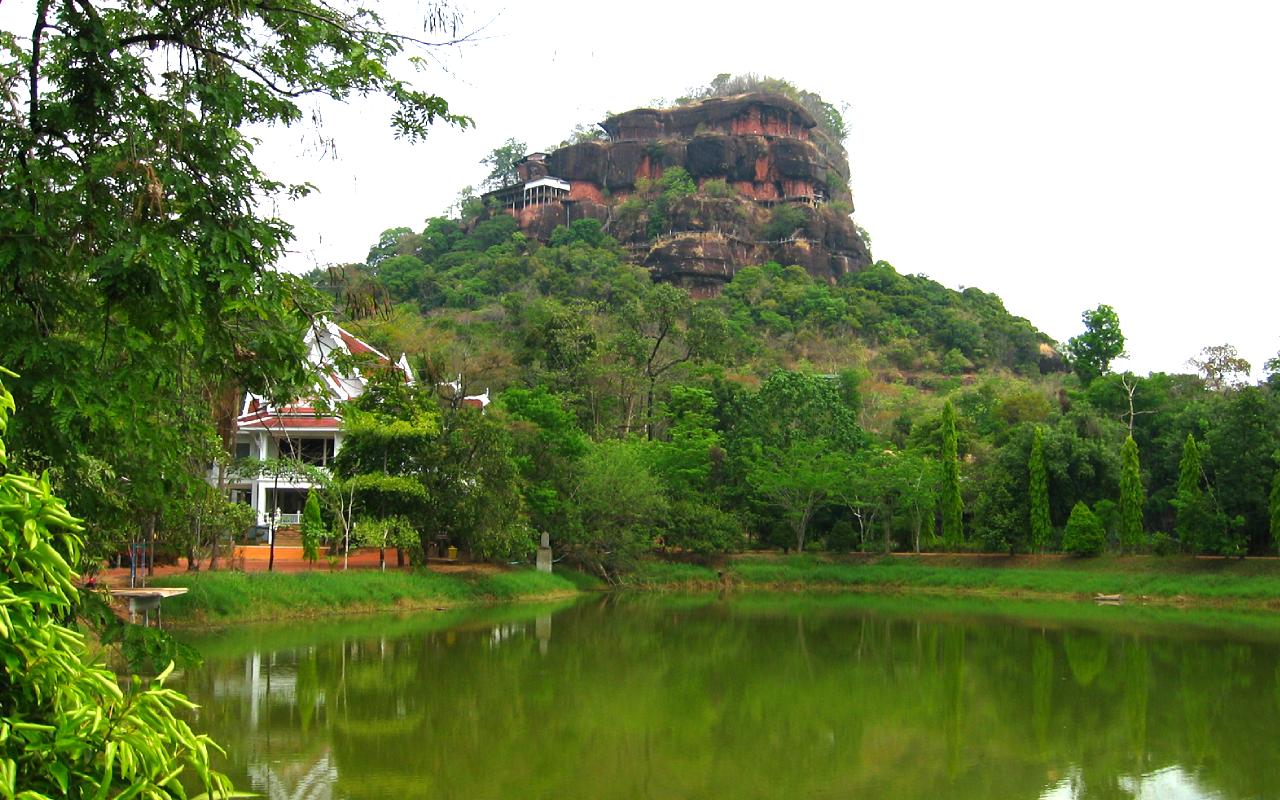
Wat Phu Tok mountain temple, meaning “Temple of the Isolated Mountain”, is a remote cliff-top Buddhist temple in northeastern Thailand’s Bueng Kan province.
Perched atop the reddish sandstone Phu Thok mountain (359 m high), it features a series of narrow wooden walkways and staircases winding around sheer cliffs.
Built in the 1970s by the forest monk Luang Pu Juan Kulachettho (Achan Chuan Kullachettho), the seven ascending levels mirror stages of Buddhist meditation and enlightenment.
Visiting Wat Phu Tok Thailand, is part adventure, part spiritual pilgrimage: the climb is challenging and vertigo-inducing, but it rewards you with breathtaking views over the Mekong plains and a profound sense of calm (e.g., the panoramic view from the summit has been called “magnificent”).
This guide covers everything a traveler needs to know: how to get there, its history and architecture, a detailed walkthrough of each level (with symbolism and sensory details), safety considerations, Buddhist context, nearby attractions, and practical tips (best times, gear, lodging, etc.).
We include maps, tables (transport options, packing checklist, sample 3-day itinerary), and a flowchart of travel decisions. Throughout, we prioritize authoritative sources: Thai tourism and news sites, travel experts, and Buddhist references.
Key points: Wat Phu Tok is accessed via Bueng Kan (or neighboring provinces), for example, Udon Thani → Bueng Kan is about 150 km (≈3 hrs by road). The climb up the mountain involves seven levels of wooden stairs and walkways, symbolizing the spiritual “path of virtue”.
It remains an active meditation site (Luang Pu Juan’s shrine is there), so visitors should be respectful (covering shoulders/knees, silence, removing shoes).
The site has no entrance fee (daily 8:00–18:00, except Songkran holidays). After reading this guide, you’ll be ready to plan your trip: know what to pack, the safest way to climb, and how to make the most of your visit to Bueng Kan’s most thrilling temple.
Introduction of Wat Phu Tok
Wat Phu Tok mountain temple lives up to its reputation as “Thailand’s most thrilling temple”. Nestled deep in the forested plains of Bueng Kan Province, Phu Thok Mountain suddenly rises up as a steep red pillar out of nowhere. A labyrinth of wooden staircases and skywalks clings to its sides – an almost impossible-looking structure that seems to float on the cliff face.
The temple complex is officially called Wat Chetiya Khiri Wihan, but it’s universally known as Wat Phu Tok. A walk through the lower grounds, lush gardens, Buddha shrines, and a memorial chedi for the founder, is inspiring on its own. But the real adventure is the staircase climb.
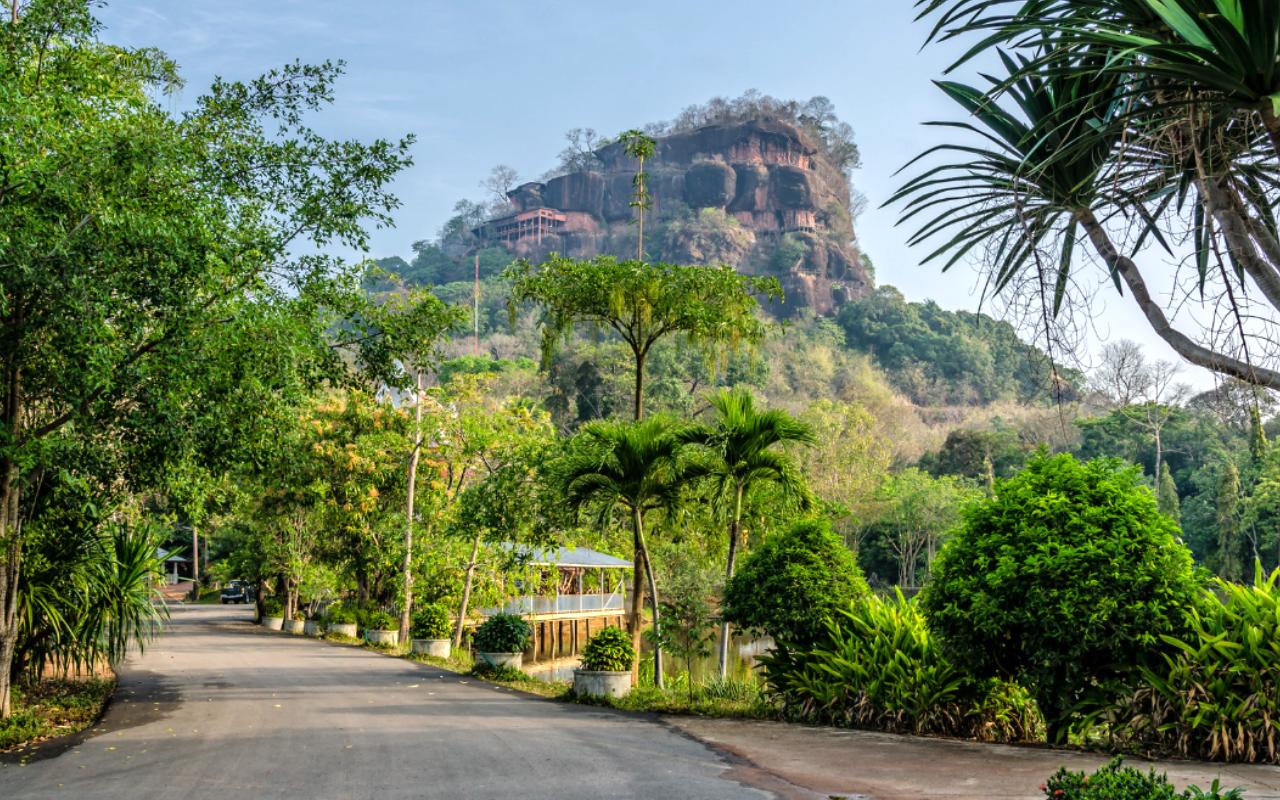
Wat Phu Tok
Over the next hour or two, you ascend through seven levels of sacred mountain trails. At each level, you pass meditation huts and shrines carved into the rock, and finally, half the path becomes an exposed wooden bridge wrapped around the cliff.
It’s equal parts exhilarating and humbling. Stepping onto those narrow planks, with sheer drops on one side and ancient Buddha figures on the other, is an experience unlike any other temple in Thailand.
This guide will take you there. You’ll learn where Phu Thok is and how to reach it, the temple’s history and Buddhist meaning, a floor-by-floor tour of the climb, plus practical tips (best times, what to bring, safety).
Along the way, we cite Thai tourism info and eyewitness accounts to paint a vivid picture. Our goal is that after reading, you’ll be ready (and excited!) to plan your own trip to this extraordinary “skywalk temple.”
Location & Access
Wat Phu Tok thailand is located in Ban Na Kham Khaen, Tambon Na Sabaeng, Si Wilai District, Bueng Kan Province (Thailand’s newest province, established 2011). This is in the far northeast (Isan region), near the Laos border and the Mekong River.
The two peaks of Phu Thok are called Phu Thok Yai and Phu Thok Noi. The temple (Wat Chetiya Khiri Wihan) sits on the south side of Phu Thok Noi.
Key distances and routes (see also Map 1 below):
- From Bangkok: About 720–750 km north by road (about 10–11 hours drive). Few direct options, so most travelers break the journey. A common approach is to fly from Bangkok to Udon Thani (flight 1.5 hours), then drive (175 km, about 2.5–3 hours) to Bueng Kan. Direct buses from Bangkok to Bueng Kan also run (10–12 hours, 700–800 THB).
- From Udon Thani: Bueng Kan is 150 km NE of Udon Thani city (2.5–3 hours by car). You can rent a car/motorbike or take a bus/minivan. There are regular minivans from Udon Thani Bus Terminal to Si Wilai town (Bueng Kan).
- From Nong Khai: Bueng Kan is 140+ km from Nong Khai (about 2–3 hours drive). Buses and minivans link Nong Khai town to Bueng Kan or Si Wilai (see below).
- From Bueng Kan town (Muang Bueng Kan): If you’re already in Bueng Kan, Wat Phu Tok is only 30 km south (less than 1 hour by car). This is often the best base for a night’s stay.
Once in Bueng Kan or Si Wilai, transportation to the temple itself is straightforward. Wat Phu Tok is on Phu Thok mountain’s flank, well signposted. Bueng Kan→Wat Phu Tok: Taxis or tuk-tuks are available (approx. 300–500 THB round-trip).
Alternatively, local Bus No. 225 runs from Bueng Kan’s clock tower to Si Wilai (45 minutes, 20 THB), then a short tuk-tuk to the temple. If you have a rental car or motorbike, parking is ample at the temple base.
History & Cultural Context
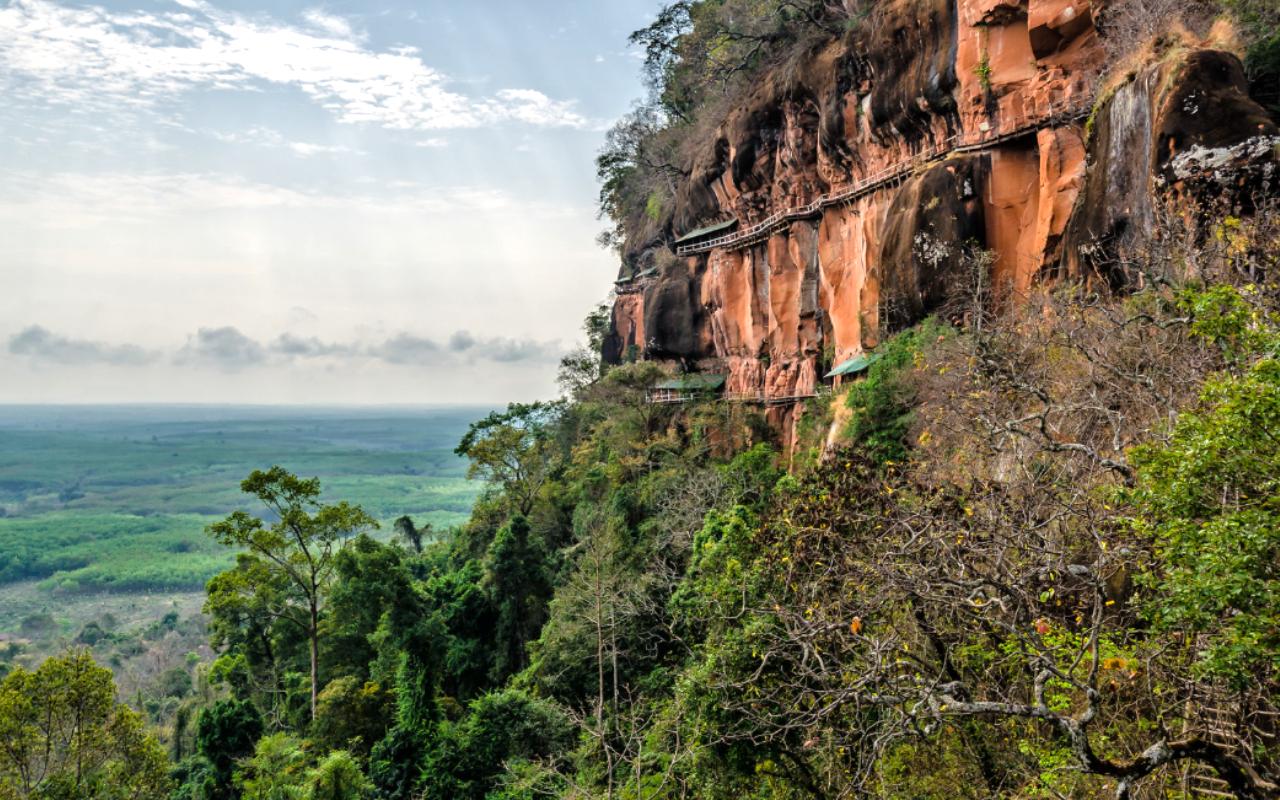
The history of Wat Phu Tok mountain temple begins with Luang Pu (Phra Achan) Juan Kulachettho (also spelled Chuan Kullachettho), a respected forest meditation master.
In the 1960s, this remote stretch of Bueng Kan was dense jungle and wildlife. Monks sought solitude here, and Luang Pu Juan founded a meditation retreat on Phu Thok for Buddhist practice.
The isolation (“Lonely Mountain”) and ruggedness symbolized a spiritual retreat, peaceful yet requiring courage to overcome fear (e.g., of snakes or heights).
Construction of the temple complex began in 1969. Luang Pu Juan led local monks, novices, and villagers in hand-building a system of wooden staircases, bridges, and walkways around Phu Thok.
Over five years, they created a meandering path up the cliff, linking caves, shrines, and meditation halls carved into the red sandstone. Each level of the climb was designed with intention: together they represent seven stages of Buddhist practice or enlightenment.
Tragically, Luang Pu Juan died in a plane crash in 1980 while en route to Bangkok. However, his vision endures. The temple’s main chedi (stupa) and museum at the base enshrine his relics and story. Wat Phu Tok (Wat Jetiyakhiri/Chetthakhiri Wihan) remains an active meditation site, managed by his disciple monks.
It is part of the Thai Forest Tradition (maha-sangha lineage) and still holds retreats and alms rituals. Visitors are therefore asked to behave respectfully: silence, no alcohol, proper dress (knees/shoulders covered), and removal of shoes in temple areas.
Culturally, Wat Phu Tok is unique among Thai temples. Most Thai wats sit in cities or villages; here, the monastery is literally on a mountain. Its architecture, the precarious wooden skywalks, was built for spiritual symbolism as much as for function.
As one travel writer notes, “the stairways to Nirvana are not for the faint of heart”, but they transform a simple path into a living metaphor of impermanence and awakening.
Today, Wat Phu Tok’s austere beauty draws pilgrims and adventurous tourists alike. The site is often included in “treasures of Isan” travel guides. In Thai media, it is highlighted as Bueng Kan’s must-see destination, and even locals come here for cycling events or meditation retreats.
Yet it remains relatively off-the-beaten-path, an inland gem far from Thailand’s usual beach or city circuits.
Architecture & The Wooden Skywalk
The architecture of Wat Phu Tok mountain temple is unlike any other temple. At ground level, you’ll find two golden chedis (chedi = stupa) in the temple courtyard and the base shrine halls.
But the real marvel begins as soon as you step into the mountain’s south face and see staircases and bridges ascending into the jungle. No plan, no concrete, just wood, rock, and faith.
The entire skywalk system is constructed of timber planks and logs anchored directly to the cliff face. Local teak and other hardwoods were manually lifted up and secured with bamboo pegs and bolts into the red sandstone.
Over the decades, the structure has been maintained by monks, but its style remains simple and rustic (no wide steel beams here!). Each section zig-zags up the rock, at times level with a cave, at times clinging to near-vertical drops.
The engineering is deceptively sturdy: visitors report that even though the planks may flex or sway slightly, they “feel pretty stable” underfoot. Many Thai villagers say they trust the construction completely; it was built with communal karma.
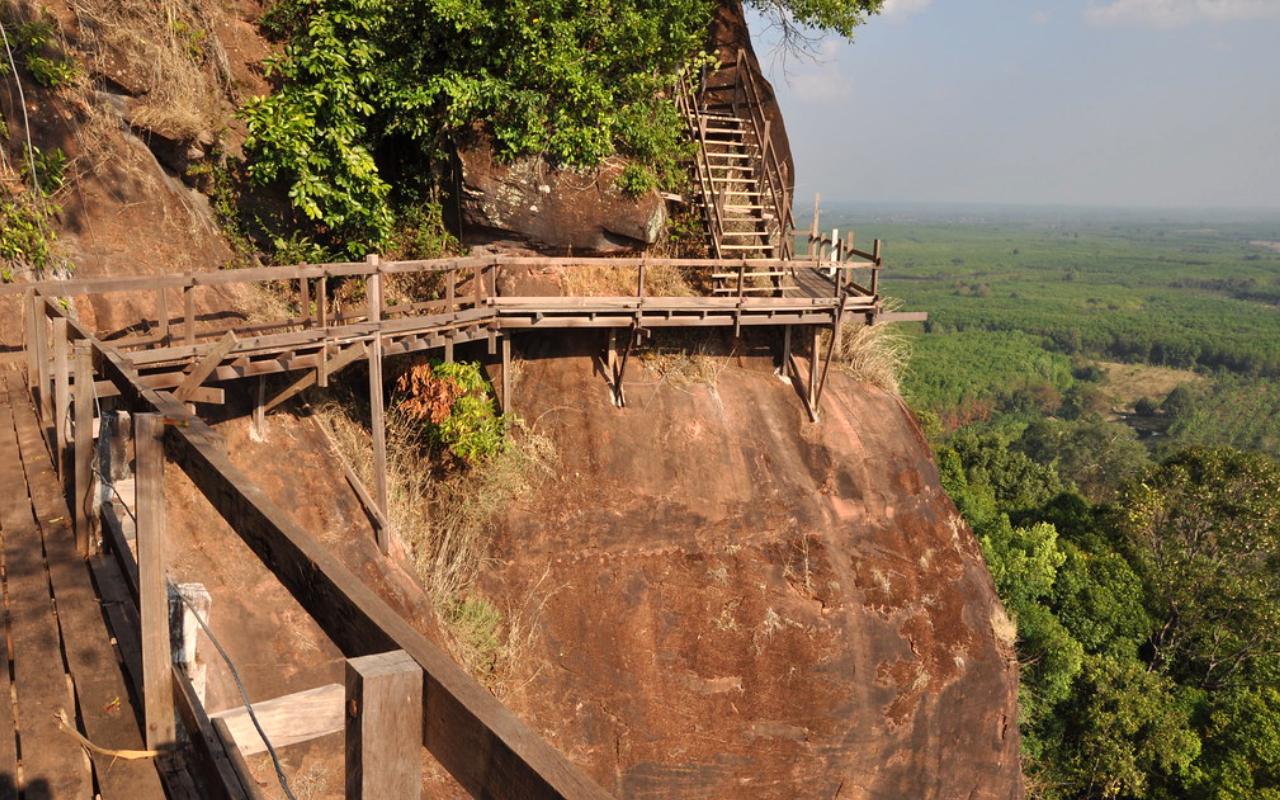
Still, the look is wild. As one guide put it, from below, “the structure looks improbable, as though someone has carefully stitched a fragile wooden ribbon around a massive stone pillar”.
Inside the mountain, at some levels, you encounter cavern shrines and halls carved from the rock. Meditation niches, old Buddha statues, and even a museum-chedi for the founder dot the path.
For example, on Level 5, there is a large ordination hall housed in a natural cave, and just outside it on a rocky promontory stands a unique little temple reachable by a wooden footbridge. From the outside, this looks like a shrine clinging to the tip of the mountain, a testament to creative use of space.
Overall, Wat Phu Tok’s design marries traditional Thai temple motifs with dramatic natural scenery. The lower halls have gilded Buddhas and naga railings like any wat, but as you climb, you suddenly find yourself on a cliff edge with a 300-meter drop below.
The contrast is intentional: the temple is a meditation site, and the architecture constantly reminds you of impermanence (the wind blowing through the trees, the creaking bridge, the sky above).
It’s easy to see why even the nation’s tourism authority notes the rock’s serenity and spiritual significance. In short, Wat Phu Tok is as much an adventure attraction as a sacred space, and its wooden skywalk is the architectural centerpiece that makes it famous.
The Seven Levels of Wat Phu Tok
The ascent of Wat Phu Tok Thailand, is divided into seven levels, each higher in altitude and symbolic meaning. (The paths themselves form a loop, so you can usually make a circuit through the levels on the climb and descent.) Below is an in-depth walkthrough of what you’ll experience level by level.
1. Level 1 – The Base Shrine & Forest Path: The journey starts at the main trail entrance, just beyond the car park and lower temple buildings. After paying respects at the base pavilion, you enter a forested path. Wooden stairs carry you gently upward through shade and birdsong.
Early on, you pass small shrines tucked into trees and a freshwater spring where locals may pause. At this stage, the temple still feels like a normal monastery, albeit with the looming mountain ahead. By the end of Level 1, the climb steepens and the forest thins.
2. Level 2 – Rocky Outcrops and Caves: Level 2 is more rugged. The trail swings out onto bare rock ledges and through shallow caves. You’ll see more Buddha images carved or placed in stone cavities.
The air may feel cooler and the silence heavier here. Look out for panels explaining Buddhist virtues etched on limestone (Thai-language signs about right effort, mindfulness, etc.). By the top of Level 2, the trail begins to hug the cliff, and wooden railings appear.
3. Level 3 – Approaching the Cliffs: As you climb higher, the path narrows. Sections of the stairway now run along a sheer drop, though guardrails protect the edge. On one side is a rock wall, on the other, a forest canopy sloping down.
The scenery opens up: now you can see across the valley to other hills and even a glimpse of the Mekong River in the distance. The air may be gusty. At intervals are small alcoves with monk statues or stone Daoism/Buddhism figures; these were placed to bless climbers. Many visitors start feeling the thrill (and fear of heights!) by this stage.
4. Level 4 – Midway Chedi and Rest Areas: Level 4 has a more substantial clearing. There is a large golden chedi (stupa) and a pavilion, shaded by trees. Pilgrims often rest here (or chant) before tackling the scary upper levels. This level feels like a halfway point.
From here, you get a good overview of Phu Thok’s two peaks and the winding path you’ve done so far. It’s also where you find simple facilities (water, toilets) provided by the temple.
5. Level 5 – Ordination Hall and Cliff Shrine: The path from Level 4 to 5 involves several steep staircases carved from rock. On Level 5 itself, the terrain levels out a bit; ironically, Level 5 is more “grounded.” Here stands the temple’s main ordination hall (ubosot), which looks like a large open cave sanctuary. It contains an altar and Buddha images; monks hold ceremonies here.
6. You can walk all around this level on solid ground. Notably, from Level 5 there is a side spur: a wooden footbridge leading to a standalone rocky protrusion. At its tip sits a tiny temple shrine. This “rock temple” is a photo-favorite – it juts out into open air with panoramic views, and is often quiet since fewer visitors make that detour.
7. Level 6 – The Famous Wooden Skywalk: After Level 5, you climb further to reach the holy grail: Level 6. Now half the loop is a skywalk. Wooden planks and railings wrap around the cliff like a narrow terrace.
Walking here is thrilling: to your side is nothing but hundreds of meters of empty sky. According to one travel writer, “about half of the circumference of the 6th level is made of wooden plank walkways, anchored into the side of the rock cliff, the highlight of visiting”.
Safety note: Though it looks precarious, many climbers report the structure feels solid and well-maintained. It is, however, exposed. If you are afraid of heights or prone to vertigo, this is the most challenging section. Steps are only a couple of feet wide; pay attention and hold the railing.
The view from Level 6 is breathtaking. Looking down reveals the Mekong River basin and Bueng Kan’s green forests below. In clear weather, you can see across the border into Laos.
Sunlight streams through the gaps in the wooden floorboards. One wanderer said, “Of course you’ll want to walk your way around to the wooden plank section, which is without a doubt the highlight of visiting”.
This level truly merges the physical with the spiritual. As you carefully tread the path, you experience the Buddhist lesson of anatta (non-self) and impermanence (the ground could vanish beneath you).
8. Level 7 – The Summit Peak: The final level is a short scramble to the very top of Phu Thok. Level 7 has only a small flat area (no major structures), since the summit is more like a narrow ridge.
As legend has it, snakes often inhabit this highest level, so the temple sometimes keeps the stairway closed at the very top. Nevertheless, some visitors do carefully proceed to “the peak” by a final ladder, where the entire 360° panorama opens up.
There are no shrines here; the reward is purely the view and the sense of having reached the highest point. (Caution: if you attempt it, climb quickly and descend; the rocks can be slippery and, yes, snakes have been spotted.)
Symbolic Meaning: The number seven is significant in Buddhism (think the Seven Factors of Awakening, or the seven chakras in some traditions). Here, each level represents a stage on the meditative path, from basic faith to higher wisdom.
Climbing physically helps one reflect inwardly. As one guide explains, the wooden bridge is “compared to a path of virtue that leads a righteous man to enter the state of freedom by their own efforts”. That is, each step is a lesson in letting go of fear, desire, or attachment. Many pilgrims chant mantras quietly on each landing, using the climb as a moving meditation.
Each level also has its own sensory feel: Level 1–4 are earthy, humid, and forested (hear birds, smell leaves); Level 5 has echoes and incense smoke in rock halls; Level 6 is windy, with the scent of teak and adrenal rush; Level 7 is open sky and peace. Together, the seven levels give a full spiritual experience, from grounded temple piety to exhilaration and back down.
The Thrill Factor & Safety
It should be clear: Wat Phu Tok mountain temple is not a gentle stroll. The wooden skywalk sections (especially Levels 5–6) earn it a reputation as Thailand’s “most dangerous temple”.
Reports and signs warn that the climb is not recommended for those with vertigo, heart problems, or a fear of heights. One journalist wrote that even a slight slip “could be fatal”, because the planks are high above ground.
However, many visitors do climb it safely with common-sense precautions:
- Stay Alert: Keep both hands free (no loose backpacks). Hold railings on steep ladders or narrow walkways. Watch where you step; some boards may have gaps or bow.
- Footwear: Wear sturdy shoes with good grip, not flip-flops or heels. The old staircase sections (some are nearly ladders) and smooth rocks demand good traction.
- Avoid Crowds: If possible, avoid busy midday when groups can bottleneck. Early morning or late afternoon climbs have fewer people and cooler temperatures.
- Weather Check: Don’t climb in heavy rain or storms, the wood can be slippery, and there’s no shelter. The temple is open 08:00–18:00 daily, but if it rains, the wooden trails may close temporarily.
- Know Your Limits: You should go back in case you feel dizzy, chest aches, or feel very anxious. If you do not want to climb higher, the beautiful views and shrines are already available at levels 1-4.
- Travel Light: The trek takes 1–2 hours. A small daypack with water and first-aid is enough. In fact, bring plenty of water; it’s tropical hot, and the climb can leave you dehydrated. Frank Hansen (writer of Frank in Asia) specifically warns: “It was a hot day.
- Follow Temple Rules: Remember, this is a sacred site. Dress modestly (cover knees and shoulders), speak softly, and do not smoke or eat on the climb. Shoes must be removed in shrine areas and any meditation huts.
The local monks do perform basic maintenance, but do not expect modern railings or lights. For example, many plank sections have only thin bamboo handrails. Still, Thai visitors regularly cross them; as Mark Wiens (a travel blogger) notes, “the actual construction feels pretty safe and secure,” despite appearances. Still, use the spirit of mindfulness on the trails: tread carefully, savor the experience, and take your time.
In short, if safety tips are followed, most healthy adults will complete the climb without incident. The shared advice is to hike slowly, enjoy each level’s meditation and views, and only push on if you feel comfortable. It helps that the temple is well-traveled; if someone needed help, others are usually nearby.
Ultimately, overcoming the fear is part of the thrill. As one visitor described, it’s “equal parts cool, thrilling, and a little bit terrifying”. However, to people who are able to go through it, it is euphoric once they get to the top, evidence of their own bravery, and a stronger resonance with a Buddhist way of going through challenges.
Spiritual Context & Buddhist Symbolism
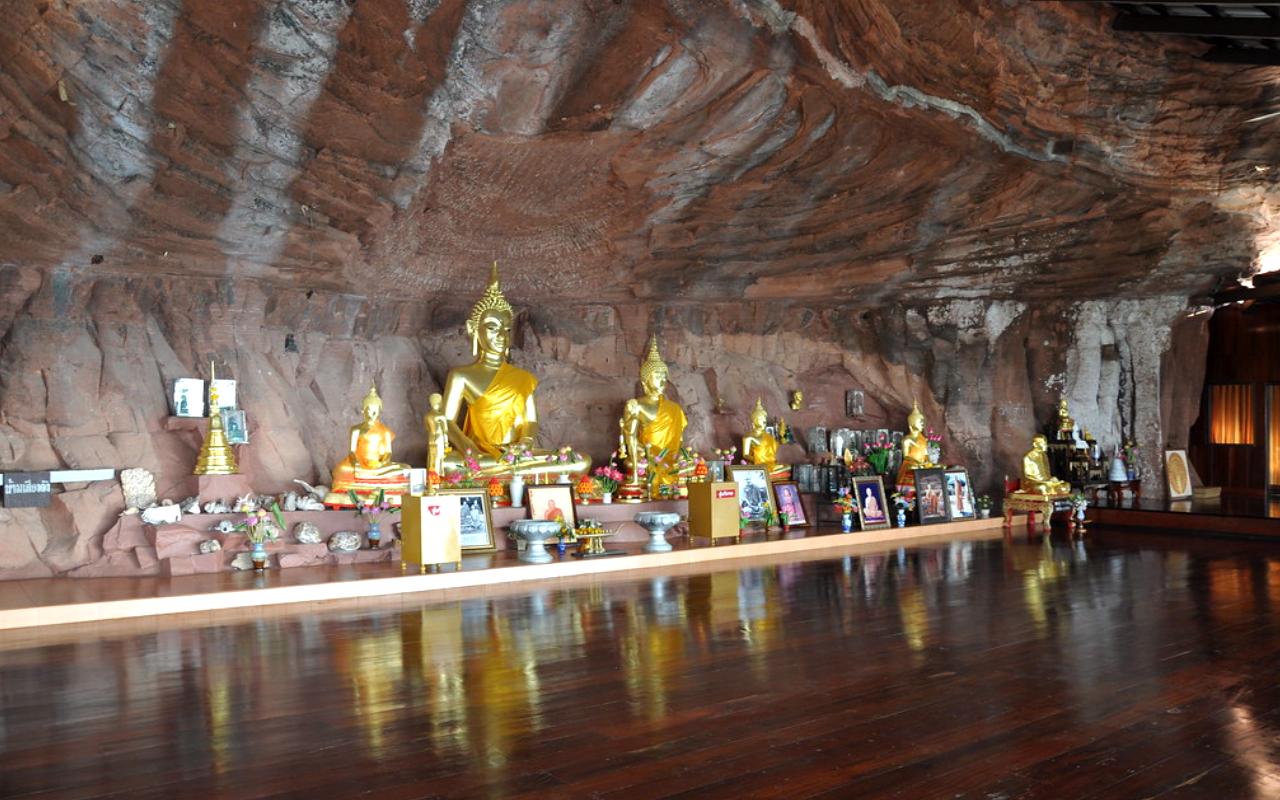
Level Five Cave: Buddha Images & Pilgrims’ Rest
Although Wat Phu Tok is exciting, it is first and foremost a Buddhist holy place. To equal its spiritual aspect, we shall unravel some of the Buddhist themes:
Meditation & Mindfulness: The temple was built as a meditation retreat. All along the trail, you’ll see signs with Buddhist teachings, and monks (often forest tradition monks in brown robes) meditating or chanting.
Climbing itself is a moving mindfulness practice: focus on each step, each breath, like walking meditation (walking kinhin). Many climbers report a profound quietude, with nothing but wind and chanting. The solitude of Phu Thok is in keeping with the Thai Forest Tradition of solitude and simplicity as a path to understanding.
The Seven Levels: As noted, the seven ascending levels correspond to Buddhist ideals. One way to see this is the “Seven Factors of Enlightenment” (Bojjhaṅgā) in Theravada practice: mindfulness, investigation of phenomena, energy, joy, tranquility, concentration, and equanimity.
Each level can be seen as a step focusing on one factor: for example, the calm of the lower caves (tranquility), the energy needed for steep climbs, joy at reaching a level, equanimity facing exposure, etc. In any case, the temple sources explicitly state the intent: “seven stages of Buddhist meditation”.
Memento Mori: Buddhist monks often remind followers of impermanence. You will notice skeleton displays or ossuaries along the path (not unique to Phu Thok, but present here), real skeletons in glass cases used to meditate on death. Frank Hansen’s account notes such a skull and skeleton exhibit. Seeing human remains is unusual in tourist Thailand, but very common in strict meditation sites (reminding one that life is fleeting).
Symbolic Journey: Practitioners say the physical effort mirrors the spiritual quest. Luang Pu Juan himself is quoted, “you have to do good and practice because you don’t know when you’ll die” (a common forest monk admonition). In climbing, one reflects on letting go of fear and ego. At the summit, many visitors feel “small in the universe”, exactly the humility Buddhism teaches.
Collective Karma: It’s said that the project was built through collective merit. Villagers, novices, and monks shared labor, creating puñña (good karma) together. This is part of why Thai Buddhists trust the structure’s safety.
For visitors, the takeaway is respect. There are no ticket checkpoints, but Wat Phu Tok is a working monastery. Many travelers leave small donations or offer incense at shrines. The monks may invite travelers to sit, drink tea, or join prayers.
Pay attention to their cues. You may also hear monks chanting Pali texts or Thai sermons about nature and morality. Absorb the atmosphere: even after the adrenaline of the climb, most visitors emerge calm and reflective, a mental shift on par with the physical accomplishment.
Practical Travel Guide for Wat Phu Tok
Transportation Options
Here is a summary of the main ways to reach Wat Phu Tok thailand (short of an international flight directly to Bueng Kan, which does not yet exist):
| Route | Details |
| Bangkok → Bueng Kan (Direct) | Bus from Bangkok (Northeastern Bus Terminal, Mo Chit or Ekamai) to Bueng Kan (10–12 hrs, 700–800 THB). |
| Bangkok → Udon Thani → Bueng Kan | Fly from Bangkok (DMK or BKK) to Udon Thani (1.5 hrs, 1000 THB+). Then drive or take a van: Udon→Si Wilai (3 hrs by minivan, 150–200 THB). |
| Bangkok → Nong Khai → Bueng Kan | Train/bus to Nong Khai (10 hrs by train, or 8 hrs by bus). Then minivan or taxi to Bueng Kan (2.5 hrs, 150 THB bus). |
| Bueng Kan City → Wat Phu Tok | Taxi/tuk-tuk from Bueng Kan (30 min, 300–500 THB round trip) or Bus 225 to Si Wilai (20 THB, 45 min) + local tuk-tuk (300 THB). |
Example: Frank in Asia notes Bueng Kan town is only “50 minutes by car” from Wat Phu Tok. If you’re driving from Udon Thani, expect 2.5–3 hours on good roads. Direct bus or train combinations will all involve one change (at Udon or Nong Khai).
Best Time to Visit
Bueng Kan has a tropical climate. The best season is the cool/dry season (Nov–Feb): sunny mornings, lower humidity. It still gets hot around 10 am, so an early start (dawn) is wise. Sunrise from the mountain can be spectacular, though very few early birds make the climb that early.
Avoid: Heavy rainy season (June–Oct) because the wood stairs become slick and the valley views are hazy. Also, the Songkran holiday (mid-April), the temple closes for a few days (Thai New Year festivities). If visiting around April 13–15, plan extra days or an alternate site (Thai temples often shut for a week over Songkran).
Entrance & Etiquette
- Opening Hours: 08:00–18:00 daily (in practice, the temple gates open at 8 AM). Last entry is around 17:30. No entrance fee, but donations are welcome at the base shrine.
- Dress Code: Wat Phu Tok is a conservative Buddhist site. Dress modestly: cover shoulders and knees (for both men and women). No bikinis, shorts, or sleeveless tops. If dressed in shorts, bring a shawl or cover-up to use on-site.
- Footwear: Remove shoes (and socks) before entering any covered shrine halls or meditation caves. You’ll be barefoot on the lower temple floor. It’s smart to wear slip-on shoes or sandals to expedite this.
- Behavior: Be calm and quiet on temple grounds. Do not eat, drink, or smoke on the paths (the no-smoking rule is enforced by Thai temple culture). Keep your head lower than any Buddha images. Do not touch monks or images.
- Photography: Allowed, but be respectful. Turn off the camera flash when inside caves or near monks. No drone use, the area is often close to a military airfield.
What to Bring
Pack light but prepared. Essential items:
- Water & Snacks: Bring at least 1–2 liters of water (pro tip: one liter per person). A small snack bar or fruit helps (some energy candy bars at one of the lower cafes). “Bring water, the seven steps to enlightenment are hard,” advises a local guide. Don’t rely solely on temple vendors, as they may only have a limited supply.
- Sturdy Footwear: Closed shoes with good traction (hiking shoes or sneakers) are a must for the uneven wooden ladders. No flip-flops.
- Sun Protection: Hat/cap and sunscreen for the lower sections and especially the climb (upper levels have little shade). Sunglasses optional.
- Modest Clothing: As above, long pants/skirts and shirts with sleeves (light fabrics are fine). A sarong can double as a knee/shoulder cover.
- Backpack: A small daypack with a water bottle holder. Free hands are better for climbing.
- First-Aid/Medications: Any personal meds, bandages, or blister plasters. Mosquito repellent if you plan to hike in the surrounding forests later.
- Camera/Phone: With extra battery or portable charger. You’ll want photos of the views!
- Cash (Thai Baht): For transportation and small purchases (donations, snacks, or tuk-tuk fare). There is no ATM at the temple. Keep coins for donation boxes.
Accessibility
- Children & Seniors: The climb is usually too strenuous for very young children, the elderly, or anyone with mobility issues. Some children have climbed if carried by parents, but be cautious. Older visitors often stay on the lower levels (still scenic).
- Facilities: There are toilets on Level 4-5 (no frills, no thrills). At the base and midway levels, there are some small shops and stands that sell water, snacks, and cold drinks. No restaurants on the mountain; bring your own lunch or eat in Bueng Kan town.
- Guides: English-speaking local guides are not common here. Most signage is Thai (though numerals and basic icons are helpful). It’s fairly intuitive to follow the path, but consider traveling with someone who’s done it or hiring a local guide from Bueng Kan if you want an in-depth explanation.
Nearby Attractions & Sample Itinerary
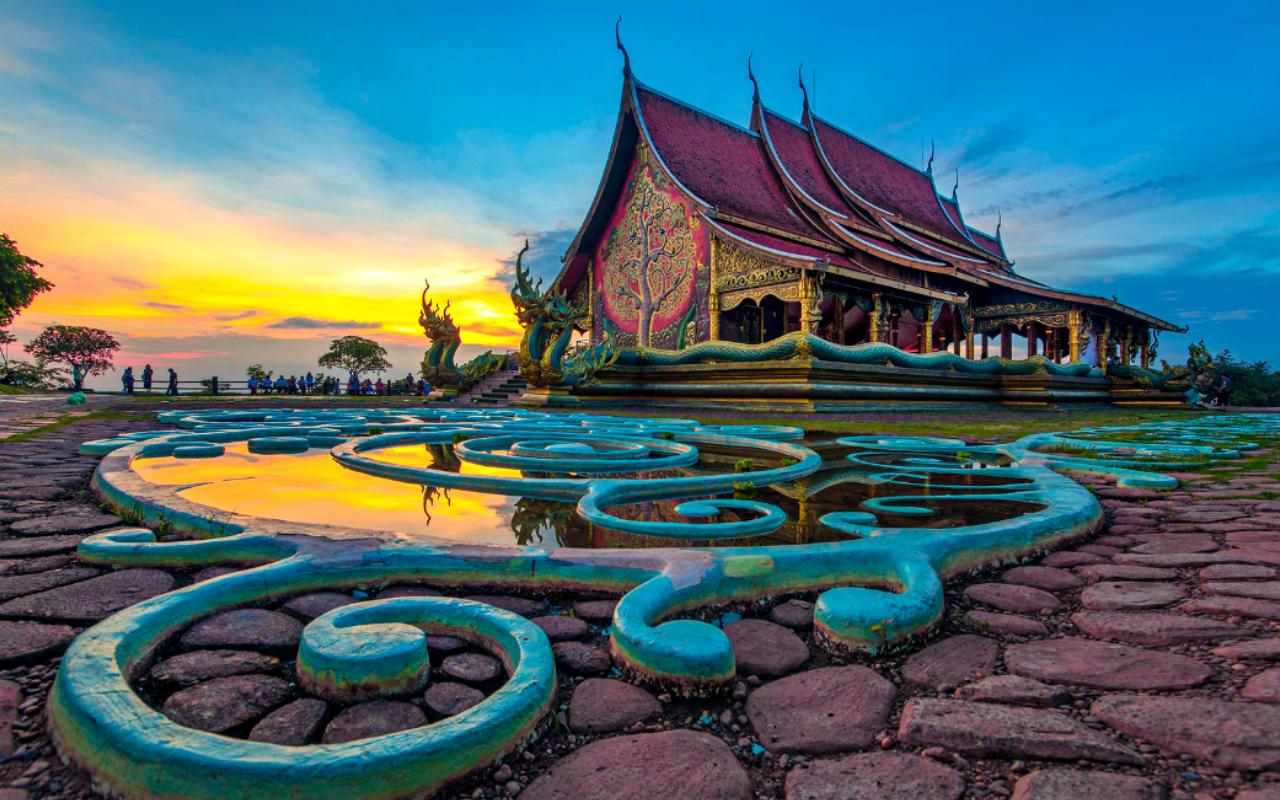
Wat Sirindhorn Wararam
If time allows, Bueng Kan has other attractions worth a day or two of sightseeing: scenic viewpoints, waterfalls, and cultural sites. A few highlights:
- Three Whale Rock (Hin Sam Wan): A limestone cliff shaped like three whales, overlooking the Mekong. About 17 km (30 min) south of Bueng Kan town. Sunset here is famous.
- Phu Sing Forest Park (Kaeng Ar-Hong): Rocky crests and pond views, good for hiking (20 km SW of Bueng Kan).
- Wat Sirindhorn Wararam (Phu Prao Temple): A luminous “glass temple” with a light-up structure near the Mekong in Sangkhom (north of Bueng Kan town).
- Tham Phra (Phu Thok) Waterfall: A 100m-wide cliff waterfall (visit by boat on Bueng Khong Long reservoir).
- Wetland Tour: Bueng Khong Long Lake (near town) is a RAMSAR site with rare fish and migratory birds. Boat tours available.
Suggested 3-Day Itinerary from Bangkok:
| Day | Morning | Afternoon | Evening |
| Day 1: Travel & Arrive Bueng Kan | Fly/Bus from Bangkok to Udon Thani (early morning). Rent a car or van to Bueng Kan (arrive noon). | Check into a hotel in Bueng Kan. Relax by the Mekong River or visit the local market. | Dinner at a riverside restaurant. Rest early for the next day. |
| Day 2: Wat Phu Tok Temple | Depart before 8 am to Wat Phu Tok (50 min drive). Climb levels 1–7 (2–3 hours round trip). | Lunch in Bueng Kan. Visit Three Whale Rock viewpoint (5–6 pm for sunset). | Night market in Bueng Kan, try Isan dishes (grilled fish, som tam). |
| Day 3: Nearby Nature & Return | Optional morning visit: Phu Sing (Kaeng Ar-Hong) or local temple (Wat Xieng Thong). | Depart from Bueng Kan to Udon Thani or Bangkok (afternoon). | — |
This itinerary assumes a return to Bangkok or onward travel on Day 3. If returning to Udon Thani, allow 3 hours driving before evening transport.
You can, of course, swap the temple and Three Whale Rock days depending on the weather. If coming via Nong Khai, consider a detour to the Laos border or Khong Chiam’s panoramic river view nearby.
Personal Experience (Traveler’s Tale)
For a vivid feel, imagine this account:
It was pre-dawn when we arrived at Wat Phu Tok’s parking area. Fog clung to the paddy fields. In the dim light, we could already make out the silhouette of Phu Thok rising tall and silent. We saw a group of Thai pilgrims in white robes filling water bottles at a well. “Sabai dee ka,” they smiled, warm and unhurried, clearly accustomed to the climb.
By 8:00 sharp, the temple opened. I stepped onto the first wooden stair. The air was cool, and only birdsong pierced the quiet. The steps began easily, through the forest, under hanging lianas. At Level 2, I paused inside a cave; a line of golden monk statues seemed to be meditating alongside us. I took off my shoes and offered a wai before the image of the temple’s founder.
Climbing higher, the canopy thinned. My legs burned on the ascent to Level 5, but the reward came as suddenly as a festival drum: a long wooden bridge around the cliff. My knees shook at first sight, earth fell away hundreds of feet below.
In that moment, all thoughts stopped: there was only the plank underfoot and the breeze in my ears. Then a group of giggling teenagers from a Bangkok tour shuffled past me as if it were only a park hike, showing how local these epic views had become.
Emerging onto the bridge, I realized it was, despite appearances, steady underfoot. I gripped the bamboo handrail and stepped along, heart pounding with awe.
On my left, for the first time, I saw beyond the forest: the Mekong snaked like a silver ribbon, and villages dotted the green plain. The sheer drop to my right was dizzying, every nook of the cliff carved by lichens and prayer inscriptions.
At the end of Level 6, the walk turned back to solid ground and ended at the summit plateau. Here are a few snakes lazily coiled in the grass (no venomous dramas that day). We drank water and gazed 360° around us, a sea of treetops, punctuated by limestone karsts. I found myself smiling. All the effort, heat, and fear had transformed into a calm clarity.
Descending was slower, almost ceremonious. The group we started with had gone ahead, so it was quiet as we retraced our steps. We chatted with a monk who offered tea at Level 4, our legs tired but our spirits light. Back at the base of the mountain, feet on soft grass, it felt like awakening from a dream.
In Bueng Kan that evening, I reflected on the climb over sticky mango rice and grilled river fish. The town felt cheerful, friendly, surprisingly lively for such a remote outpost.
I realized Wat Phu Tok had given me two gifts: a rush of adventure and a sense of serene perspective. “One of the most unique meditation sites in the world,” I’d read, and I nodded in agreement from my hammock by the river.
(If you write your own story, it will differ; maybe you’ll come by bicycle or do it barefoot! But the mountain will do the telling of itself once you’re on those wooden stairways.)
Nearby Attractions & Combined Itineraries
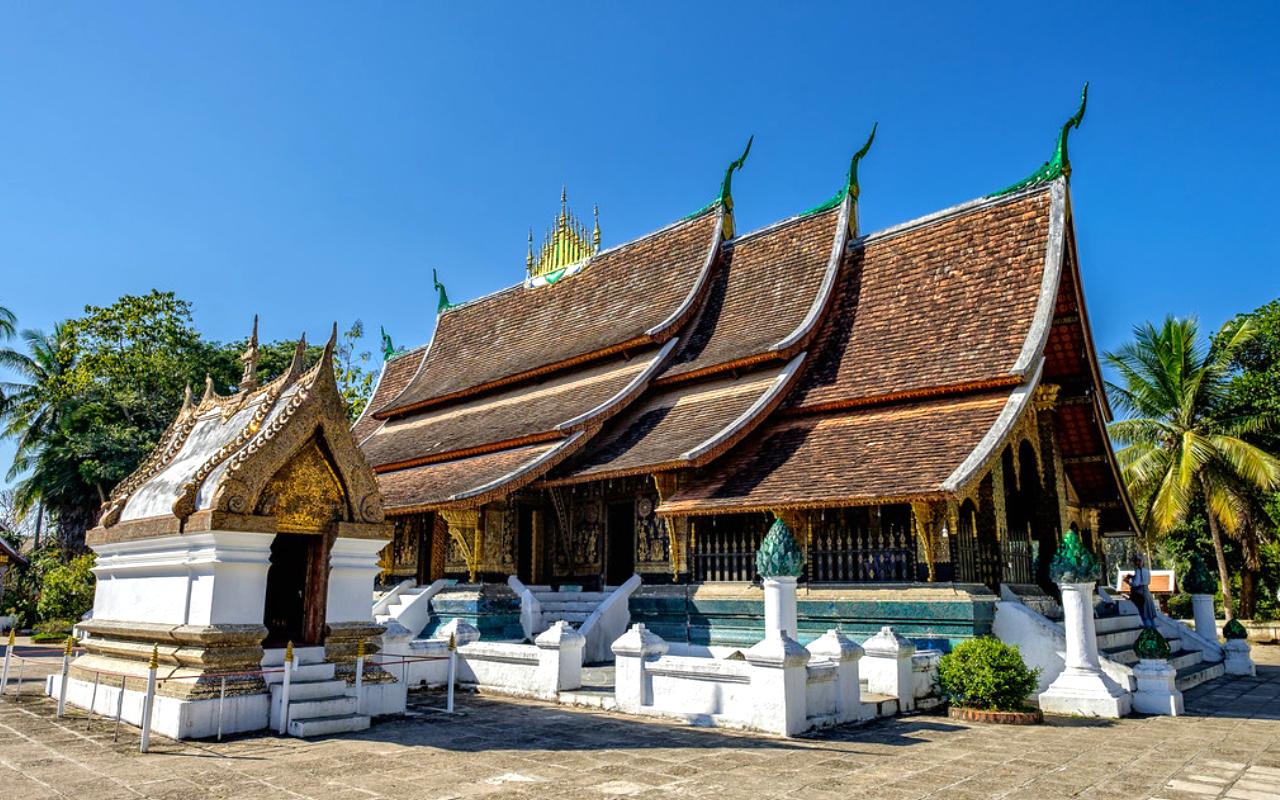
Wat Xieng Thong
Many travelers combine Wat Phu Tok with other Bueng Kan sites, especially if staying 2–3 nights. Here are a few suggestions:
- Three Whale Rock (Hin Sam Wan): Located in Na Sabaeng district, this cliff resembles a whale family. A short trek leads to viewing platforms. Best at dawn/sunset. It’s only 5 km northeast of Wat Phu Tok, so some visitors do both in one morning.
- Phu Sing (Kaeng Ar-Hong) Forest Park: About 30 km south of Bueng Kan town. It has jungle trails and granite outcrops. A scenic drive or a 1–2 hour hike here is refreshing.
- Bueng Khong Long Wetland: Boat tours on the Bueng Khong Long reservoir (13 km south of Bueng Kan) are popular. This Ramsar wetland has unusual fish and migratory birds, plus the Tham Phra waterfall (a 100m-wide cascade).
- Wat Xieng Thong (Wat Pa Sutthio): A riverside temple in Bueng Kan famous for a large sitting Buddha and a Naga staircase.
If you have more time, other Isan gems like Udon Thani’s archaeological parks or the Mekong sunrise at Khong Chiam (near Ubon Ratchathani) are doable from Bueng Kan as side trips.
FAQs
Q: Is Wat Phu Tok safe to climb?
A: Yes, Wat Phu Tok mountain temple is generally safe if proper precautions are followed (hold railings, watch your step, avoid bad weather). Many Thais climb it regularly. That said, it is steep and can be nerve-wracking. Only climb if you are reasonably fit and not severely afraid of heights. Consider skipping Levels 5–6 if you feel unsafe, since the lower temple halls are still beautiful.
Q: How long does it take?
A: visit to Wat Phu Tok, Thailand, usually takes around 2–3 hours for the round-trip climb at a moderate pace. Some fit travelers do it in 90 minutes, but factor in rest, photos, and temple bows, mark at least 2 hours. Many guidebooks suggest allocating a morning (or a half day including travel) to comfortably enjoy it.
Q: Are there any fees?
A: Entrance is free (though a small donation box at the base is there). If you hire a guide or driver, that’s extra. On-site food/drink is modestly priced (water 20 THB, snacks 30–50 THB).
Q: What if it rains?
A: In heavy rain, the wooden parts become slippery. The temple may temporarily close the upper walkway sections. If the rain is light, the climb is still possible, but be careful. Ideally, choose a dry morning. (There’s no indoor shelter halfway up except the caves/halls.)
Q: Can I stay overnight at Wat Phu Tok?
A: No guest accommodations on-site. Most visitors stay in Bueng Kan town (about 30 min away). There are several mid-range hotels and guesthouses by the river. If you want a unique stay, some places offer “farm homestay” experiences near Si Wilai.
Q: Any special permits or Buddhist holidays?
A: No permit needed for foreigners. Note that the Thai New Year (Songkran, mid-April) often closes many temples for a few days. Otherwise, normal Thai Buddhist holy days see local pilgrimages (calm crowd). Dress especially respectfully during Vesak/Poya days.
Conclusion
Wat Phu Tok mountain temple truly blends adventure, beauty, and spirituality. There’s nothing else quite like this “skywalk temple” in all of Thailand. As you descend the final wooden ladder, most climbers feel a mix of relief and exhilaration.
You’ve navigated a literal path of virtue, overcoming fear and ascending step by step. The reward is not just the panoramic vista or a good story, but a deep calm: you’ve done something challenging in a sacred space, and returned changed, even if just a little.
For travelers seeking an offbeat Thailand experience, Wat Phu Tok checks every box: it’s photogenic, photoreal (no plastic facsimiles), and off the beaten path (Bueng Kan sees far fewer tourists than Chiang Mai or Phuket).
You’ll return with not just photos but insights: about Buddhist philosophy, the power of meditation, and maybe about yourself (after all, those wooden stairs won’t let you complain).
To quote one pilgrim: “Wat Phu Tok remains a site of pilgrimage and meditation, the climb is not just a test of physical endurance, but a reminder of impermanence”.
We invite you to climb, contemplate, and discover the wonder of Wat Phu Tok. It may just become the highlight of your Thailand journey, and certainly a story to tell for years. Safe travels, and phra rūn kahn (good luck) on the temple mountain!










-
 0115 Best Easy Treks in Nepal for Beginners and Families
 -
 02Best season for Everest Base Camp Trek
 -
 03Best Time to Go Hiking in Nepal: A Seasonal Guide for Trekkers
 -
 04Suchi Purja –Wife of Nirmal Purja aka Nims Dai
 -
 05Dubai desert safari outfit ideas
 -
 06Top Beaches in Sri Lanka
 -
 0710 Best Easy Treks in Nepal